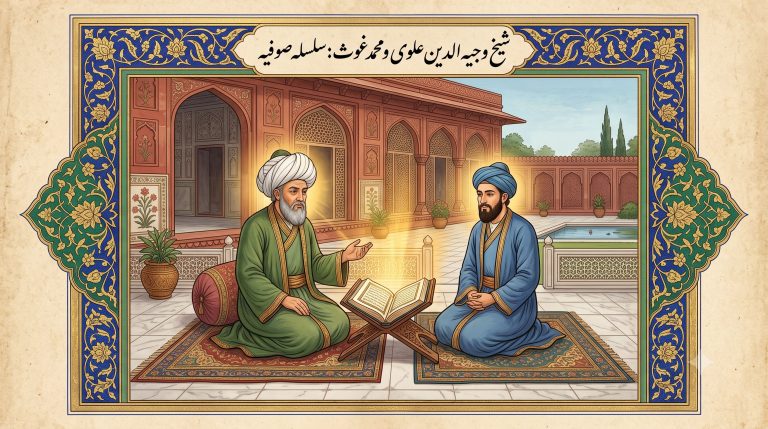
Sheikh Wajihuddin Alavi Gujrati’s work connected with Tafsir al-Baydawi belongs to a scholarly practice that can be difficult to understand from a list of book titles alone. It was a hashiyah: a set of learned marginal notes or glosses written in conversation with an established commentary. This form shows how scholars read closely, tested explanations, and taught advanced students.
Three layers of scholarship
The Qur’an is the revealed text. A tafsir explains its language, context, legal implications, and theology. A hashiyah then comments on a commentary, often clarifying a difficult phrase, comparing interpretations, or raising a question about the commentator’s reasoning.
The work discussed in Mohammad Khalid’s thesis is associated with Anwar al-Tanzil wa Asrar al-Ta’wil, the celebrated commentary of the thirteenth-century scholar Nasir al-Din al-Baydawi. Sheikh Wajihuddin did not write al-Baydawi’s commentary. His contribution belongs to the next layer: sustained engagement with that text.
This distinction matters. Calling every book in the chain “Wajihuddin’s tafsir” would hide the collaborative nature of the tradition. A more accurate description is that he wrote a gloss on al-Baydawi’s commentary.
Why scholars wrote glosses
A compact classical commentary may contain grammar, rhetoric, theology, law, variant readings, and earlier interpretations in only a few lines. Students therefore needed teachers who could unpack its compressed arguments. A gloss could preserve that teaching.
Such notes might explain why a grammatical construction affects meaning, identify a source left unnamed in the base text, or compare one interpretation with another. They could also record disagreement. The page might therefore contain several voices: Qur’anic text, the commentator, the later glossator, a copyist, and even later marginal readers.
This layered page reflects a culture of careful reading. Authority did not remove the need for examination. Respect for an earlier work could be expressed through patient analysis.
What the supplied thesis establishes
Khalid gives this work the first detailed place in his chapter on Arabic writings whose manuscripts he studied. The section begins at printed page 269 of the thesis and includes manuscript and catalogue information. A cited entry from the Government Oriental Manuscripts Library and Research Institute helps locate the work within a surviving manuscript tradition.
The physical record is valuable even when a full critical edition is unavailable. Catalogue descriptions can identify a title, author attribution, script, folio count, copyist, date, opening words, closing words, and condition. Those details help researchers determine whether two records describe the same work or different copies.
They do not answer every question. A catalogue attribution is evidence, but it is not automatically proof that the copy is in the author’s hand. A copy date identifies that manuscript, not necessarily the date of composition. Notes added by later readers must also be separated from the original gloss.
How to read this work responsibly today
The next research step should be a verified manuscript description followed by a scholarly edition. Researchers would compare all available copies, establish the base text, mark variants, and distinguish Wajihuddin’s words from the text he cites. Translation should follow that work, especially where a short technical phrase depends on grammar or a theological convention.
For general readers, the safest lesson is already clear. Sheikh Wajihuddin’s scholarly life joined Sufi teaching with the close study of Arabic texts. His work on al-Baydawi points to an educational world in which spiritual formation and disciplined textual study were not separate pursuits.
The manuscript also encourages humility. We can describe its place in the commentary tradition and the evidence reported by the thesis. Detailed claims about its interpretation should wait for a reliable reading of the Arabic text.
Source note
Based on Mohammad Khalid, Life and Works of Sheikh Wajihuddin Alavi Gujrati, PhD thesis, Aligarh Muslim University, 2011, printed pp. 269-287 (supplied PDF pp. 306-324). Earlier catalogue material is cited through Khalid unless stated otherwise.