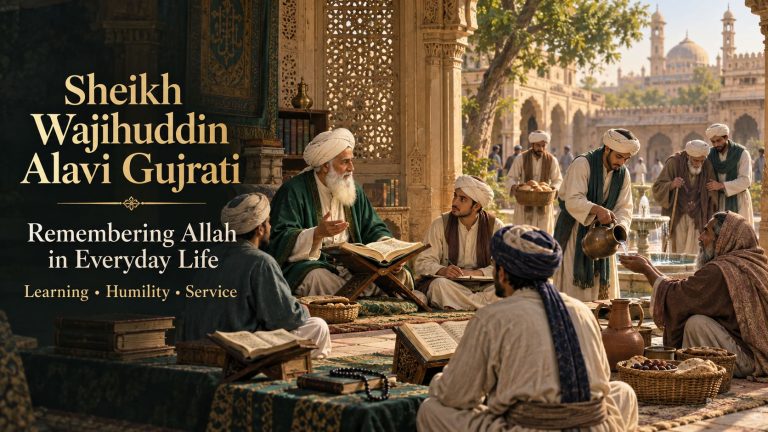
Two titles in the recorded works of Sheikh Wajihuddin Alavi Gujrati open different windows onto Sufi life: the Malfuzat, a record of sayings and conversations, and the Awrad, a collection of regular devotional recitations. Mohammad Khalid’s thesis describes manuscript witnesses for both works, while Mustafa Husain Alvi’s English biography preserves a later selection of translated teachings. [1, 2, 3]
These sources are valuable precisely because they are not identical. Reading them responsibly requires us to distinguish spoken teaching from a written compilation, an author’s hand from a copyist’s hand, and a manuscript description from a modern practical guide.
What is a malfuzat?
The word malfuzat refers to spoken words that have been recorded. In Sufi literary history, such a collection may preserve answers to questions, advice to students, short reflections, or conversations remembered by people around a teacher.
This form differs from a book deliberately composed chapter by chapter. The teacher may be the source of the sayings without being the person who wrote the surviving copy. A listener may have taken notes; a later compiler may have arranged them; and a still later scribe may have produced the manuscript that reaches a library.
Khalid describes a manuscript titled Malfuzat-i Shaykh Wajih al-Din Alawi at Maulana Azad Library, Aligarh Muslim University. His description includes physical and scribal information and refers to a copyist and colophon. [1] That evidence supports the existence of a manuscript record of sayings. It does not by itself make the volume an autograph work in Sheikh Wajihuddin’s own handwriting.
What is an awrad collection?
Awrad is the plural of wird, a regular portion of remembrance, prayer, or recitation. An awrad collection normally organizes devotional material for repeated use. It belongs to a different literary function from a record of conversations.
Khalid’s next manuscript description concerns Awrad-i Shaykh Wajih al-Din Alawi Gujarati. He reports it through the Nawab Bahadur Manzil Allah Khan collection and notes features of the copy. [2] As with the Malfuzat, this is a historical catalogue description. Present location, access conditions, and attribution should be checked with the holding institution before a digital edition is announced.
An awrad manuscript also should not be converted casually into online spiritual instructions. A manuscript may contain contextual practices, variant readings, scribal errors, or guidance intended for a particular teaching relationship. Editing and using it responsibly require textual comparison and qualified religious scholarship.
How spoken guidance became a book
Alvi’s biography offers a narrative bridge between oral teaching and written collections. It says that people recorded Sheikh Wajihuddin’s words when he spoke in Gujri, Persian, or Arabic, and that his sayings circulated in booklets. Alvi then gives English renderings of selected teachings. [3]
This passage helps readers imagine a possible chain of preservation: the teacher speaks, listeners record, compilers arrange, scribes copy, libraries preserve, scholars describe, and translators introduce the material to a new audience.
Each stage can add value, but each can also introduce change. A listener may summarize. A compiler may group separate occasions together. A copyist may misread a word. A translator may choose one meaning among several. Good scholarship makes those stages visible rather than presenting every surviving sentence as if it came directly from a modern recording.
Related sources are not automatically the same text
The translated sayings in The Sun in a Candle should not be identified automatically with the Malfuzat manuscript described by Khalid. Alvi names Tazkiratul Wajih as his principal source and draws on several earlier works. Khalid, meanwhile, describes a specific manuscript in a university collection. [1, 3]
Establishing a textual relationship would require the original-language passages. Researchers would need to compare wording, order, headings, omissions, and the chain of citation in both books. Until that work is done, the safest description is that the sources preserve overlapping traditions of remembered teaching.
The same caution applies to large numbers attached to Sheikh Wajihuddin’s works. A title recorded in a bibliography, a manuscript described in a thesis, and a printed edition available today are three different claims.
Building a responsible digital edition
A future digital project could make these materials much more useful. For each manuscript it should provide:
- a current library record and shelfmark;
- clear images of the opening, closing, and colophon;
- a diplomatic transcription that preserves the copy’s wording;
- a normalized reading where necessary, with every correction marked;
- an English translation reviewed by specialists in the language and subject;
- notes identifying Qur’anic verses, hadith, earlier authors, and later editorial additions; and
- a statement explaining whether the work is an autograph, an attributed compilation, or a later copy.
This method respects both devotional value and historical evidence. It enables readers to benefit from the teaching while understanding how the text reached them.
Two forms of a living tradition
The Malfuzat and Awrad represent two complementary forms of preservation. One records guidance exchanged through speech; the other organizes devotion through repeated practice. Both show that a Sufi legacy is carried not only by formal treatises, but also by conversations, routines, students, scribes, and communities of readers.
Their survival also reinforces a larger lesson from Sheikh Wajihuddin’s library: preservation is an intellectual and ethical responsibility. Accurate titles, honest attribution, careful copying, and transparent editing protect a tradition from both loss and exaggeration.
Sources
- Mohammad Khalid, Life and Works of Sheikh Wajihuddin Alavi Gujrati, PhD thesis, Aligarh Muslim University, 2011, printed p. 413; supplied PDF p. 450, for the Malfuzat manuscript description.
- Khalid, printed p. 414; supplied PDF p. 451, for the Awrad manuscript description and reported collection.
- Mustafa Husain Alvi, The Sun in a Candle: Life and Teachings of Hazrat Shah Wajeehuddin Alvi, supplied undated PDF, pp. 84-89. The translated teachings are Alvi’s presentation and are not equated here with Khalid’s manuscript.
- Alvi, pp. 9-12 and 104, for his principal-source acknowledgement and English-language purpose.