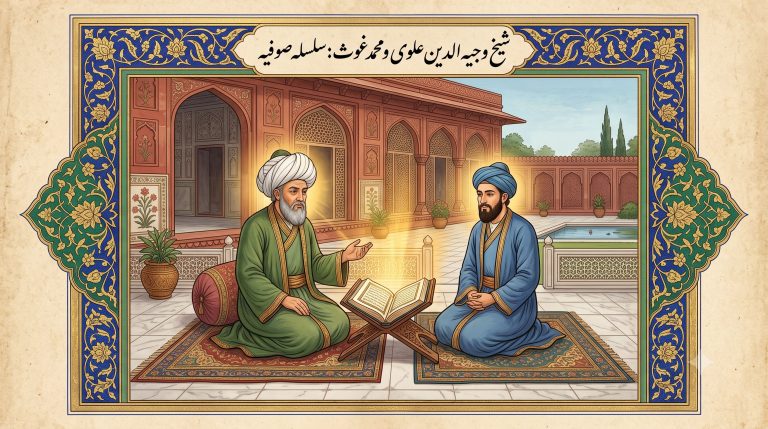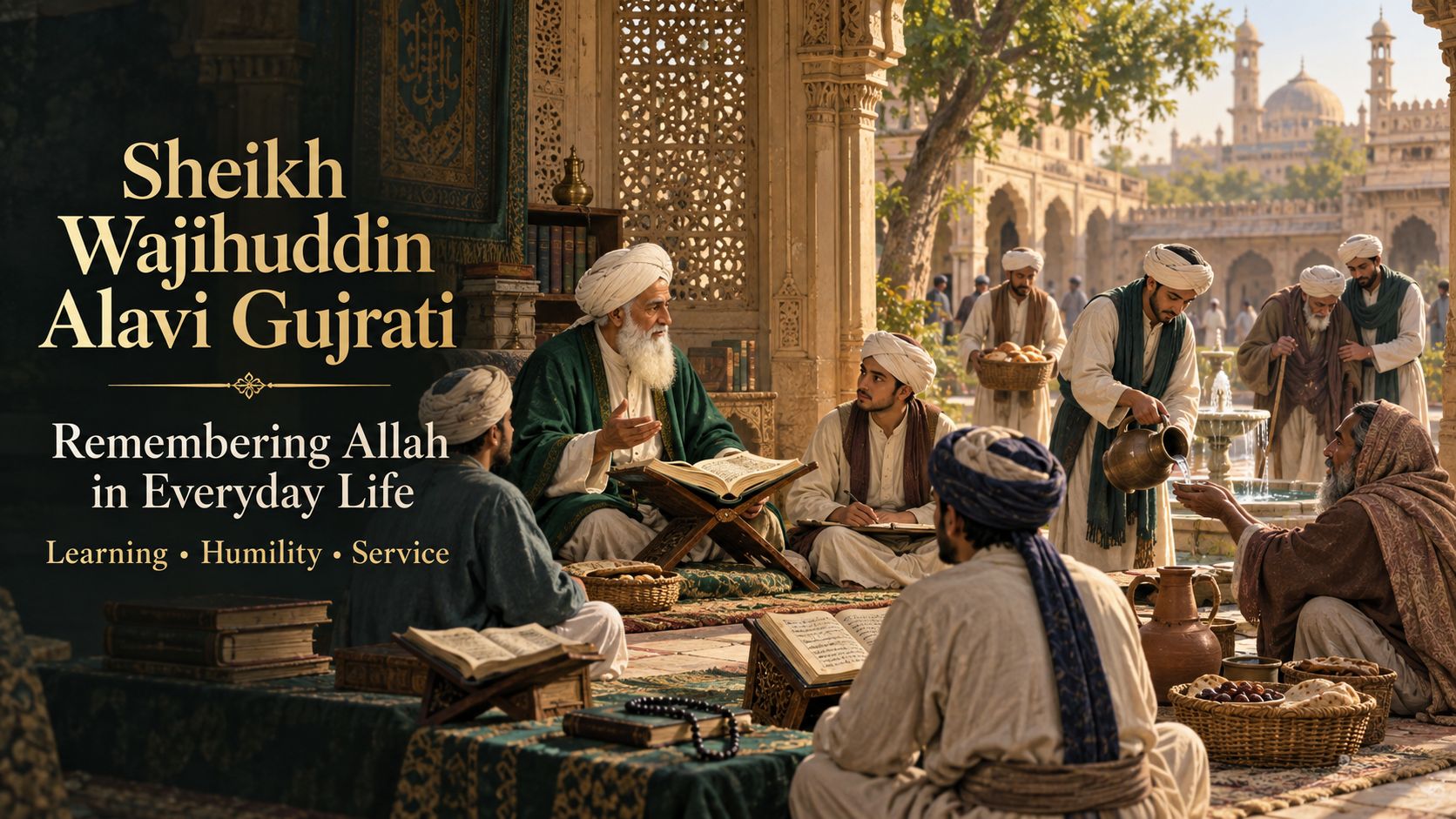
Sheikh Wajihuddin Alavi Gujrati’s teachings on remembrance, humility, and service are known in English through the “Golden Words” selection in Mustafa Husain Alvi’s The Sun in a Candle. Paraphrased here, the selection returns to five themes: remembrance of Allah (dhikr), consistency, learning, humility, and service through action. The sayings are attributed teachings that have not been matched word for word to an original manuscript.
How does spiritual learning become part of everyday conduct? In The Sun in a Candle, Mustafa Husain Alvi presents teachings attributed to Sheikh Wajihuddin Alavi Gujrati that return to this question through familiar concerns: attention, effort, pride, learning, and kindness to other people.
The book’s “Golden Words” section offers an English selection of sayings and reported conversations. Alvi acknowledges the difficulty of carrying their meaning and character into another language. The themes below are paraphrased from his presentation, with reflections on what they invite a reader to consider today. [1] For the teacher’s biography, see Who Was Sheikh Wajihuddin Alavi Gujrati?
The five themes at a glance
| Theme | What the selection emphasises |
|---|---|
| Remembrance | Returning to dhikr, the remembrance of Allah, when attention wanders [1] |
| Consistency | A shorter practice maintained regularly can be more fruitful than a longer practice performed irregularly, conveyed through the image of repeated drops of water affecting stone [2] |
| Learning | Knowledge and focused learning are repeatedly valued, in keeping with the educational life described in the biographical accounts [3] |
| Humility | The desire for respect and glory is presented as an obstacle to the learner’s purpose [4] |
| Service | Ordinary actions such as helping older people and showing kindness to the poor are connected with devotion [5] |
Reading note: The reflection questions and everyday applications in this article are editorial. They are not additional sayings attributed to the Sheikh.
What do the teachings say about remembering Allah?
The selection opens with an emphasis on remembering Allah and noticing habits that draw a person away from that remembrance. Later, a reported conversation describes a student troubled by distraction. The guidance turns his attention back to dhikr, the remembrance of Allah. [1]
Read together, these passages give remembrance a continuing place in the learner’s life. It is something to return to as attention wanders and daily demands accumulate. For wider background on remembrance, intention, and self-purification, see our introduction to what Sufism (tasawwuf) is and how ihsan shapes it.
For a reader reflecting on these teachings, a useful question is: what regularly receives my attention, and what do I repeatedly neglect? This is a contemporary reflection on the passages, rather than an additional saying attributed to the Sheikh.
Why does consistency matter in spiritual practice?
One passage places particular weight on regularity. Alvi reports that a shorter practice maintained consistently can be more fruitful than a longer practice performed irregularly. He conveys the lesson through the image of repeated drops of water gradually affecting stone. [2]
The image directs attention to patient effort. What seems small in a single moment can acquire significance through repetition.
The principle also invites reflection on study and service. A learner who returns regularly to a text, or a volunteer who reliably keeps a commitment, gives continuity to an intention. These examples are applications for today’s readers; the original passage concerns spiritual study and practice.
How do the teachings keep learning central?
The selected teachings repeatedly value knowledge and focused learning. This emphasis fits the educational life described in both Alvi’s biography and Mohammad Khalid’s thesis. The thesis’s account of the madrasa brings formal subjects, spiritual guidance, and attention to students into the same setting. [3] That account is explored in detail in Sheikh Wajihuddin’s madrasa in Ahmedabad: learning and care for students.
That relationship gives the teachings a concrete background. They were preserved in connection with a person remembered for teaching others, answering questions, and maintaining a community of learners.
Learning also requires openness. A question can reveal something a student has not yet understood. Returning to a lesson can expose assumptions that passed unnoticed the first time. Such reflections help us read an emphasis on knowledge as an ongoing responsibility. The part that teachers and companions play in that openness is the subject of suhbah in Sufism: learning through good company.
What do the teachings say about humility?
Another passage describes the attraction of respect and recognition during a student’s spiritual journey. Alvi’s selection presents the desire for glory as an obstacle to the learner’s purpose. It also includes advice against making the expectation of extraordinary experiences the aim of spiritual practice. [4]
Near the end of a later section, the author recounts Wajihuddin discouraging a person who praised him in verse and redirecting attention toward experience and effort. This is a reported anecdote, and its theme is consistent with the caution about recognition in the sayings. [4]
For readers today, the question is personal: does the wish to appear learned begin to compete with the willingness to learn? The passages encourage attention to that possibility without giving us a reason to judge someone else’s inner state. For practical examples of courtesy, listening, and receiving correction, see our guide to adab in Sufism and good manners as a daily spiritual practice.
How do the teachings connect devotion with service?
The selection also connects the body’s ordinary actions with devotion. Helping older people, showing kindness to the poor, visiting others, listening to guidance, and reciting the Qur’an appear within this account of how a person directs their faculties. [5]
The emphasis on assistance has a parallel in the biographical material. Khalid describes generosity toward students and people in need, while Alvi’s account remembers Wajihuddin distributing gifts and responding to others’ difficulties. [5]
These passages give service a practical meaning. Someone needs help, and another person pays attention and responds. For an educational or community institution, that invites reflection on the care offered to students, neighbours, older people, and families facing hardship.
The teachings can be read slowly, alongside the biography that gives them a setting. A useful place to begin is with one question: which responsibility already before me deserves greater consistency, humility, or care?
Frequently asked questions about Sheikh Wajihuddin’s teachings
What are the main themes of Sheikh Wajihuddin’s teachings in The Sun in a Candle?
In Mustafa Husain Alvi’s “Golden Words” selection, the themes discussed here are returning to remembrance (dhikr), consistency in practice, the value of learning, humility, and service expressed through action. This article paraphrases those themes and adds reflections for today’s readers.
Are these Sheikh Wajihuddin’s exact words?
Not necessarily. The sayings are known through Alvi’s English presentation, and they have not been matched word for word to an original manuscript. Alvi acknowledges the difficulty of carrying their meaning and character into another language, so this article paraphrases them.
What does the selection say about remembering Allah?
It opens with an emphasis on remembering Allah and noticing habits that draw a person away from that remembrance. A reported conversation describes a student troubled by distraction, and the guidance turns his attention back to dhikr, the remembrance of Allah.
Why does consistency matter in these teachings?
Alvi reports that a shorter practice maintained consistently can be more fruitful than a longer practice performed irregularly, conveyed through the image of repeated drops of water gradually affecting stone. The passage concerns spiritual study and practice; the applications to study and volunteering are editorial reflections.
What do the teachings say about humility?
Alvi’s selection presents the desire for respect and glory as an obstacle to the learner’s purpose, and it includes advice against making the expectation of extraordinary experiences the aim of spiritual practice. A reported anecdote recounts Wajihuddin discouraging a person who praised him in verse and redirecting attention toward experience and effort.
How do the teachings connect devotion with service?
The selection connects the body’s ordinary actions with devotion, mentioning helping older people, showing kindness to the poor, visiting others, listening to guidance, and reciting the Qur’an. The biographical material adds accounts of generosity toward students and people in need.
Which sources does this article use?
The sayings come from Mustafa Husain Alvi’s English presentation in The Sun in a Candle: Life and Teachings of Hazrat Shah Wajeehuddin Alvi. Mohammad Khalid’s 2011 PhD thesis, Life and Works of Sheikh Wajihuddin Alavi Gujrati (Aligarh Muslim University), supplies biographical context, not verification of the exact English sayings.
Related reading: his life and legacy, his madrasa in Ahmedabad, his relationship with Muhammad Ghawth, and more in Sufi Heritage.
Sources
The sayings discussed here are known through Mustafa Husain Alvi’s English presentation in The Sun in a Candle: Life and Teachings of Hazrat Shah Wajeehuddin Alvi, supplied undated PDF. They have not been matched word for word to an original manuscript. Page numbers below refer to the PDF viewer.
- Alvi, pp. 84, 89; p. 84 contains his introduction to the translated selection.
- Alvi, p. 89. The applications to study and volunteering are editorial reflections.
- Alvi, p. 85; Mohammad Khalid, Life and Works of Sheikh Wajihuddin Alavi Gujrati, PhD thesis, Aligarh Muslim University, 2011, printed pp. 215-218 / PDF pp. 252-255. Khalid supplies biographical context here, not verification of the exact English sayings.
- Alvi, pp. 85, 87, 95. The response to praise is an anecdote reported by Alvi.
- Alvi, pp. 62, 64-65, 86-87; Khalid, printed pp. 225-226 / PDF pp. 262-263. The books draw on some overlapping earlier sources.