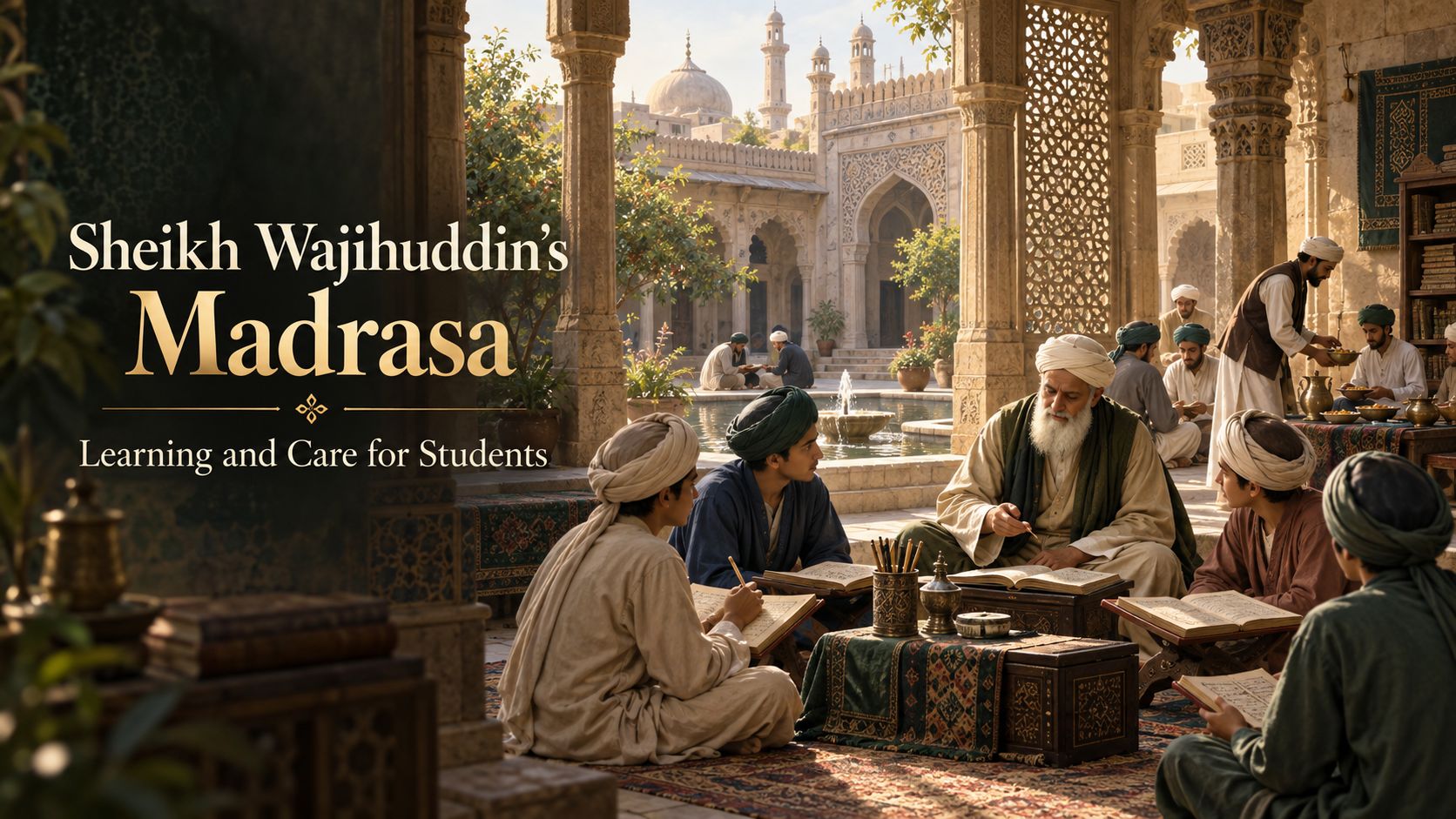
Sheikh Wajihuddin Alavi Gujrati’s madrasa in Ahmedabad, the Madrasa Aliya Alaviya, was a sixteenth-century school in the Sultanate of Gujarat. According to Mohammad Khalid’s doctoral thesis, Wajihuddin began teaching in 933 AH (roughly 1526–27 CE), and the madrasa was established in 935 AH (roughly 1528–29 CE) during the reign of Sultan Bahadur Shah. Khalid describes a broad curriculum, practical provision for students, and an associated library.
The history of a school can be told through the subjects it teaches. It can also be told through the care that makes learning possible. In Mohammad Khalid’s account of Sheikh Wajihuddin Alavi Gujrati, these two histories belong together.
His madrasa in Ahmedabad appears as a place of sustained teaching, a broad curriculum, and practical provision for students. The account gives us a way to think about education through the everyday work of a teacher and the needs of those who came to learn. For his biography, see Who Was Sheikh Wajihuddin Alavi Gujrati?
Madrasa Aliya Alaviya at a glance
| Detail | What the sources report |
|---|---|
| Institution | Madrasa Aliya Alaviya, Ahmedabad, Gujarat |
| Teaching began | 933 AH (roughly 1526–27 CE), according to Khalid [1] |
| Madrasa established | 935 AH (roughly 1528–29 CE), during the reign of Sultan Bahadur Shah of Gujarat, according to Khalid [1]. Alvi’s p. 41 gives a different foundation-year statement that requires reconciliation [5]. |
| Subjects listed | Qur’anic interpretation, hadith, jurisprudence, literature, logic, philosophy, mathematics, and astronomy [2] |
| Spiritual instruction | Guidance in tasawwuf for some students [2] |
| Student support | Accommodation, financial provision, and a physician, reported through earlier writers [2] |
| Continuity of teaching | Lessons reportedly interrupted on only four occasions (an attributed account) [3] |
| Library | Books connected with his students and other scholars; present condition not established [4] |
When was the madrasa founded?
Khalid dates the beginning of Sheikh Wajihuddin’s teaching to 933 AH (roughly 1526–27 CE). He places the establishment of the Madrasa Aliya Alaviya in 935 AH (roughly 1528–29 CE), during the reign of Sultan Bahadur Shah of Gujarat. These are separate milestones: the beginning of his teaching and the foundation of the institution. [1]
The thesis explains that teaching could begin around a learned individual before acquiring the buildings and support associated with a larger school. As students gathered, educational activity could become the basis of an institution.
In Wajihuddin’s case, Khalid describes a school whose reputation drew students from a wider area. The account connects its growth to the teacher’s scholarly standing and the instruction available there. [1]
Mustafa Husain Alvi’s biography gives a different foundation-year statement, so this article retains Khalid’s explicitly attributed dates. [5]
What subjects were taught at the madrasa?
The subjects listed in the thesis include Qur’anic interpretation (tafsir), hadith, jurisprudence (fiqh), literature, logic, philosophy, mathematics, and astronomy. Other passages describe legal principles, rhetoric, and disputation as part of the school’s intellectual life. [2]
These lists are useful because they show the range of learning associated with the institution. Religious study involved close attention to language and interpretation, while the curriculum also included disciplines concerned with reasoning and the natural world.
The thesis also describes spiritual instruction alongside formal study. Some students received guidance in tasawwuf, and Wajihuddin’s teaching life included attention to their personal circumstances. [2] For background on the term, see what Sufism (tasawwuf) is and how ihsan shapes it; his own spiritual relationships are discussed in Sheikh Wajihuddin Alavi and Muhammad Ghawth.
For a present-day reader, the combination raises an interesting educational question: how can a school support both intellectual development and the formation of character? That is a reflection prompted by the historical account, rather than a claim that the madrasa followed a modern educational model.
How did the madrasa support its students?
Khalid gathers accounts of accommodation and financial provision for students. He also reports the presence of a physician for their care. These details appear in the earlier descriptions he quotes when discussing the school’s development and support. [2]
Such provision deserves a place in the history of learning. A student who travels to study needs somewhere to stay, the means to meet daily expenses, and help during illness. The thesis’s account allows us to see the school as a community with practical responsibilities as well as a curriculum.
Mustafa Husain Alvi’s The Sun in a Candle adds a vivid account of this attention. After the day’s lessons, it describes Wajihuddin visiting the students’ quarters, checking their comfort, and answering questions about spiritual matters even when the conversation continued late. The classroom relationship extended into the circumstances in which students lived and studied. [5]
Khalid also describes attention to students’ needs beyond formal lessons. Taken together, the accounts show how personal care belongs to the way this teacher was remembered. They draw on some of the same earlier biographical traditions, so the overlap is not necessarily independent confirmation of each detail. [2], [5]
Teachings attributed to Wajihuddin in the same book are summarised in our article on remembering Allah in everyday life: learning, humility, and service.
How consistent was his teaching?
The thesis emphasizes the continuity of his teaching. It repeats an earlier account that his lessons were interrupted on only four occasions. This is best read as a reported testimony to his dedication; the thesis does not supply a daily attendance register through which to verify an exact count. [3]
The broader point is well supported within the biography: teaching occupied a central place in how he was remembered.
What is known about the madrasa library?
Khalid describes a library associated with the madrasa, containing books connected with his students and other scholars. [4]
The library extends the story beyond spoken lessons. Books made it possible to revisit arguments, preserve explanations, and continue learning after a particular gathering had ended.
What can readers learn from the madrasa’s history today?
The madrasa’s history offers several themes for readers interested in education: breadth of study, continuity of teaching, attention to students, and care for books. Each gives a concrete dimension to the idea of serving knowledge.
For an educational community today, the account invites reflection on familiar responsibilities. What allows a student to remain in education? How are teachers supported in sustained work? How are books and other learning resources preserved for the next generation?
These questions provide a useful way to engage with the historical example while keeping its own setting in view.
Readers interested in the wider themes of conduct and companionship in learning may continue with adab in Sufism and good manners as a daily spiritual practice and suhbah in Sufism: learning through good company.
Frequently asked questions about Sheikh Wajihuddin’s madrasa
What was the Madrasa Aliya Alaviya?
According to Mohammad Khalid’s doctoral thesis, the Madrasa Aliya Alaviya was Sheikh Wajihuddin Alavi Gujrati’s madrasa in Ahmedabad, established in 935 AH (roughly 1528–29 CE) during the reign of Sultan Bahadur Shah of Gujarat. Khalid presents it as a place of sustained teaching, a broad curriculum, and practical provision for students.
When did Sheikh Wajihuddin begin teaching?
Khalid dates the beginning of his teaching to 933 AH (roughly 1526–27 CE) and the establishment of the madrasa to 935 AH (roughly 1528–29 CE). These are separate milestones. Mustafa Husain Alvi’s book gives a different foundation-year statement that requires reconciliation, so this article retains Khalid’s explicitly attributed dates.
What subjects were taught at the madrasa?
The thesis lists Qur’anic interpretation, hadith, jurisprudence, literature, logic, philosophy, mathematics, and astronomy. Other passages describe legal principles, rhetoric, and disputation as part of the school’s intellectual life. The thesis also describes spiritual guidance in tasawwuf for some students.
How did the madrasa support its students?
Khalid gathers accounts of accommodation and financial provision for students and reports the presence of a physician for their care. Mustafa Husain Alvi’s The Sun in a Candle describes Wajihuddin visiting the students’ quarters after lessons, checking their comfort, and answering questions about spiritual matters. Because the accounts draw on some of the same earlier traditions, the overlap is not necessarily independent confirmation of each detail.
Was Sheikh Wajihuddin’s teaching ever interrupted?
The thesis repeats an earlier account that his lessons were interrupted on only four occasions. This is best read as reported testimony to his dedication; the thesis does not supply a daily attendance register through which to verify an exact count.
Did the madrasa have a library?
Khalid describes a library associated with the madrasa, containing books connected with his students and other scholars. The historical descriptions do not establish the library’s present condition or holdings.
Which sources does this article use?
The article draws mainly on Mohammad Khalid’s 2011 PhD thesis in Arabic, Life and Works of Sheikh Wajihuddin Alavi Gujrati (Aligarh Muslim University), and on Mustafa Husain Alvi’s The Sun in a Candle: Life and Teachings of Hazrat Shah Wajeehuddin Alvi. Page references appear in the sources list below.
Related reading:
- Who Was Sheikh Wajihuddin Alavi Gujrati?
- Sheikh Wajihuddin Alavi and Muhammad Ghawth: Sufi Lineage
- Remembering Allah in Everyday Life: Learning, Humility, and Service
- More in Sufi Heritage
Sources
Mohammad Khalid, Life and Works of Sheikh Wajihuddin Alavi Gujrati, PhD thesis in Arabic, Aligarh Muslim University, 2011.
- Printed pp. 215-216; supplied PDF pp. 252-253.
- Printed pp. 216-218; supplied PDF pp. 253-255. Accounts of institutional provision are cited through Khalid’s discussion of earlier writers, including Abdul Hayy Hasani, Abu Zafar Nadwi, and Sayyid Husayni Pir Alavi.
- Printed p. 218; supplied PDF p. 255. The four interruptions are an attributed historical account.
- Printed pp. 219-220; supplied PDF pp. 256-257. The historical library descriptions do not establish its present condition or holdings.
- Mustafa Husain Alvi, The Sun in a Candle: Life and Teachings of Hazrat Shah Wajeehuddin Alvi, supplied undated PDF, pp. 39-40. For the sources Alvi acknowledges, see pp. 9-12. This article retains Khalid’s explicitly attributed dates; Alvi’s p. 41 gives a different foundation-year statement that requires reconciliation.