Al-Hashmi • Sufi heritage
Shuttari Sufi Heritage
From Bihar and Gujarat to the Deccan. Explore the Shuttari teachers, scholarly families and places of remembrance that connect Hazrat Abdullah Shuttari, Sheikh Wajihuddin Alavi and Hazrat Hashim Peer Dastageer.
بِسْمِ اللَّهِ الرَّحْمَٰنِ الرَّحِيمِ
In the name of Allah, the Most Merciful, the Most Compassionate. May Allah send blessings and peace upon our master Muhammad and his family.Understanding the tradition
Learning, remembrance and companionship
The Shuttari silsilah is a Sufi tradition transmitted through teachers and their disciples. Its Indian history includes centres of instruction in Mandu, Bihar, Gwalior and Gujarat, with later connections to the Deccan. The lives remembered here bring together religious learning, spiritual discipline and service. A silsilah records a chain of spiritual transmission. Khilafah, in this setting, means a teacher’s authorization to guide others. It may pass to a son, a relative or another disciple. A family genealogy answers a different question: who descends from whom. This guide brings together the Al-Hashmi shajra, the two studies of Sheikh Wajihuddin, historical research and community remembrance. The honorific rahmatullahi ‘alayh—may Allah have mercy on him—is intended for the departed teachers mentioned throughout.A recorded line of transmission
From Abdullah Shuttari to Hashim Peer
The following sequence appears in the Shuttari section of Shajra-e-Tayyibah: Qadiriyyah, Shuttariyyah, printed page 13. It represents the line recorded in that source; the wider tradition also contains other branches. [1]- Hazrat Abdullah ShuttariAssociated with the establishment of the order in India
- Shaykh Qadan Shuttari ManeriMuhammad ‘Ala; remembered in Bihar
- Hazrat Abul Fath Hidayatullah SarmastThe Bihar tradition
- Hazrat Shaykh Zahoor Haji HuzoorAlso written Zuhur or Zohur
- Hazrat Muhammad Ghawth GwalioriGwalior and Gujarat
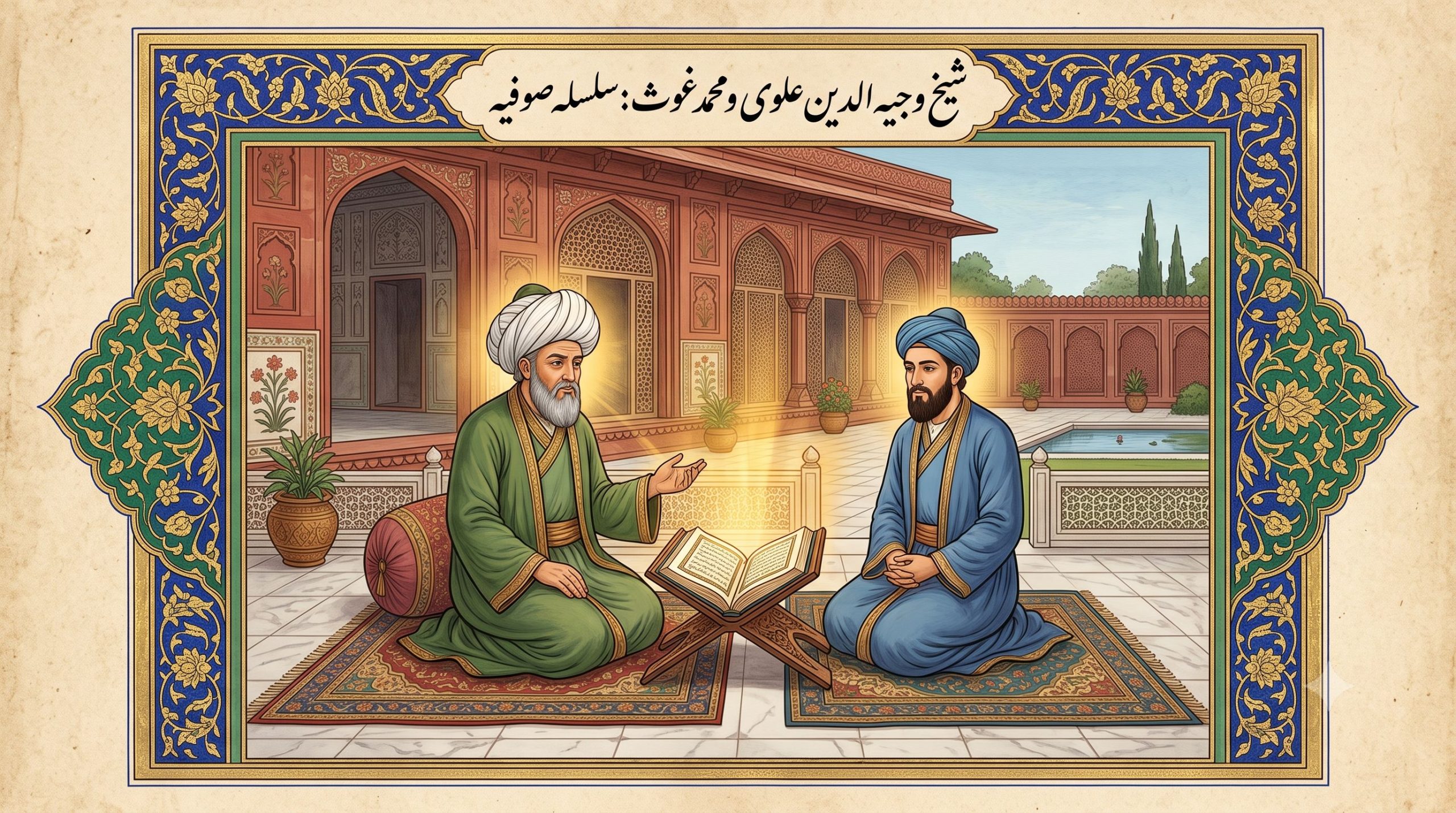
- Hazrat Wajihuddin Husayni AlaviAhmedabad
- Hazrat Shah Abdullah HusayniSon of Sheikh Wajihuddin
- Hazrat Hashim Peer Dastageer HusayniBijapur, now Vijayapura
Mandu and Bihar
The early Shuttari teachers
Hazrat Abdullah Shuttari
Hazrat Abdullah Shuttari is remembered as the principal figure associated with establishing the Shuttari silsilah in India. Mandu, in present-day Madhya Pradesh, became an important centre of his teaching. The community’s account names him at the beginning of its Indian succession. The Al-Hashmi shajra places him within a longer spiritual chain, making clear that the Indian story belongs to a broader tradition.Sources: Al-Hashmi shajra, pp. 12–13 [1]; Ahmad, chapters I–II [4].
Hazrat Muhammad ‘Ala Qadan
The community account remembers him as Hazrat Allauddin Kaazan Shuttari or Shaikh Mohammed Ulaa. The shajra uses Qadan Shuttari Maneri; Qazi Moin Uddin Ahmad’s historical study uses Muhammad ‘Ala Qadin. Ahmad identifies him as Abdullah Shuttari’s khalifah and describes his settlement at Vaishali. His writings include Ma‘adin al-Asrar and Awrad-i-Qadin Shuttar, linking his legacy to teaching as well as the remembrance of his shrine.Sources: shajra, p. 13 [1]; Ahmad, pp. 17–25 (PDF pp. 38–46) [4]. Spellings vary between sources.
Hazrat Abul Fath Hidayatullah Sarmast
Remembered as a son and successor of Muhammad ‘Ala Qadan, Hidayatullah Sarmast connects the Vaishali and Hajipur traditions. His name appears between Qadan and Zahoor Haji Huzoor in the Al-Hashmi shajra. Ahmad records differing accounts of his training, a meeting with Humayun in 1539, and his settlement at Hajipur. The historical description places his mausoleum near the Gandak. These details make the circulated death year of 1538 uncertain.Sources: shajra, p. 13 [1]; Ahmad, pp. 29–31 (PDF pp. 50–52) [4].
Hazrat Zahoor Haji Huzoor
His name appears as Zahoor, Zuhur or Zohur Haji Huzoor; Ahmad discusses him as Zahur Hamid. Ahmad connects his training with both Qadan and Hidayatullah. Muhammad Ghawth identifies him as his master in the account of Jawahir-i Khamsa. His importance here is the teaching relationship that connects the Bihar tradition with Muhammad Ghawth. The conflicting date pair “1523 CE / 990 AH” should not be repeated as a settled chronology; see the historical note below.Sources: shajra, p. 13 [1]; Ahmad, pp. 34–37 [4]; Ernst [5].
Gwalior • Ahmedabad • Bijapur
Scholarship and the journey south
Hazrat Muhammad Ghawth Gwaliori
Muhammad Ghawth, also written Ghaus or Ghous, is a major figure in this transmission. His Persian Jawahir-i Khamsa brings together prayer, remembrance and forms of Sufi discipline. Carl W. Ernst’s study identifies Zahoor Haji Huzoor as his master and records the work’s revision in Gujarat in 1549. [5] Both Wajihuddin biographies discuss Muhammad Ghawth’s place in Sheikh Wajihuddin’s spiritual life. This connection helps explain how a teacher associated with Gwalior also became central to the Shuttari story in Ahmedabad. [2] [3]Sheikh Wajihuddin Alavi Gujrati
Born in Champaner to a learned family, Sheikh Wajihuddin was the son of Shah Nasrullah. He became known in Ahmedabad as a scholar, teacher and spiritual guide. The sources use several spellings, including Wajeehuddin, Wajihuddin, Alvi and Alavi. The Al-Hashmi shajra also preserves the title Haydar ‘Ali Thani. [1] His biographies describe childhood learning, study with teachers and his later work educating others. His madrasa belongs to that later teaching career. Religious scholarship and spiritual training are closely connected in these accounts. [2] [3] The birth year differs: Mustafa Husain Alvi gives 910 AH, while Mohammad Khalid discusses 911 AH alongside the alternative. Both sources discuss his death under 998 AH. His shrine is remembered in Khanpur, Ahmedabad.Khalid, pp. 210–221; Alvi, pp. 24, 34–41, 79–82. Exact dates and the shrine’s construction history require comparison of the differing accounts.
Shah Abdullah and Hashim Peer Dastageer
Shah Abdullah Husayni, the son of Sheikh Wajihuddin, occupies the next place in the recorded chain. Hazrat Hashim Peer Dastageer—also written Hasham Husayni—follows him and is associated with Bijapur in Karnataka. The Wajihuddin studies identify Hashim as Sheikh Wajihuddin’s nephew and the son of Sayyid Burhanuddin. They describe his earlier education and his further spiritual training with Shah Abdullah. These relationships connect family life, learning and authorized guidance without making them interchangeable. Reading Hashim Peer’s life beside the Ahmedabad biographies gives the Deccan story an important context: the tradition travelled through people who studied, served and maintained relationships across regions.Sources: shajra, p. 13 [1]; Khalid, pp. 240–241 [2]; Alvi, pp. 100–102 [3].
The family behind the scholarship
Sheikh Wajihuddin’s ancestral context
The family account in The Sun in a Candle traces earlier roots to Hadramawt and Makkah, followed by settlement in Gujarat. It associates Bahauddin with Patdi and describes a family in which religious teaching and service as a qazi, or judge, were important. These are transmitted family accounts, rather than a newly authenticated genealogy. [3] The relevant names appear in the Al-Hashmi family genealogy in this order:Kabiruddin → Bahauddin → Muinuddin → ‘Ata Muhammad → Imaduddin → Nasrullah. The shajra’s printed page 16 uses ‘Ata Muhammad; the English biography and community notes use Atauddin. That variation is retained here for readers comparing the sources. Sheikh Wajihuddin is identified as Nasrullah’s son in his biographies.
This family sequence is separate from the spiritual chain above. It also explains why calling Kabiruddin simply Wajihuddin’s “great-grandfather” would obscure several intervening generations. [1] [3]Community remembrance
Further names in the regional tradition
The community account also remembers the following teachers and places. These associations are presented as community testimony; each deserves its own sourced biography before a detailed succession or family relationship is assigned. [6]- Sufi Sarmast Ali Shah Qalandar Husayni — Nandura, Buldhana district, Maharashtra.
- Sufi Abdullah Shah Husayni Qadri Shuttari — Bijapur, Karnataka.
- Sufi Ghafoor Shah Qalandar Husayni Qadri Shuttari — Pune, Maharashtra.
- Sufi Hidayatullah Shah Husayni Qadri Shuttari — Nandura, Buldhana district.
- Hazrat Ataullah Shah Shuttari — Bengaluru, Karnataka.
Reading the sources with care
Why are some dates left open?
Some biographical notes pair Zahoor Haji Huzoor’s death in 1523 CE with 990 AH, which are incompatible. Ahmad instead prints 22 Dhu al-Hijjah 930 AH, but his accompanying Gregorian year also needs checking. The reported 1538 death date for Hidayatullah conflicts with Ahmad’s account of a 1539 meeting with Humayun. The page therefore preserves the evidence without assigning an unverified exact date. [4]Was Muhammad Ghawth an adopted child named Khatiruddin?
One community narrative appears to combine names and relationships. Ernst’s study records Muhammad Ghawth’s own genealogy as Muhammad son of Khatir al-Din and names Zahoor Haji Huzoor as his teacher. It supports the teacher–disciple connection, but not the proposed identification of Ghawth himself as a child called Khatiruddin. [5]How should shrine stories and devotional accounts be read?
Stories of dreams, blessings and extraordinary events belong to the devotional memory preserved by these communities. They should be identified as such. They also need to be distinguished from dated records, manuscript descriptions and evidence about buildings. Historic place descriptions are not current visitor directions. Confirm the shrine’s local name and access with its caretakers before travelling, particularly where older notes use uncertain spellings such as “Sivani” or give a railway landmark without a verified address.A short glossary
- Silsilah / shajra
- A spiritual chain, and a document or chart recording it. A shajra may also record family descent, depending on its heading and purpose.
- Khalifah / khilafah
- An authorized spiritual successor, and the authorization given by a teacher in this context.
- Khanqah
- A place associated with Sufi teaching, companionship and devotional life.
- Mazar / dargah / ‘urs
- A mazar is a tomb visited in remembrance; dargah commonly refers to its shrine setting. An ‘urs commemorates a saint’s death anniversary.
For further study
Sources and reading
- Shajra-e-Tayyibah: Qadiriyyah, Shuttariyyah. Al-Hashmi Trust, Urdu edition consulted. Spiritual chain: printed pp. 12–14, especially p. 13 (PDF p. 14); relevant family sequence: printed p. 16 (PDF p. 17). Names were checked against the page images.
- Mohammad Khalid, Life and Works of Sheikh Wajihuddin Alavi Gujrati. PhD thesis, Department of Arabic, Aligarh Muslim University, 2011. Family, education and chronology: printed pp. 210–221 (PDF pp. 247–258); Hashim connection: pp. 240–241 (PDF pp. 277–278). PDF edition consulted.
- Mustafa Husain Alvi, The Sun in a Candle: Life and Teachings of Hazrat Shah Wajeehuddin Alvi. English edition consulted; publication date not established. See pp. 24–34, 39–41, 56–59, 79–82 and 100–102. Its family and devotional perspective is valuable, while some dates and narrative details require comparison.
- Qazi Moin Uddin Ahmad, History of the Shuttari Silsilah. PhD thesis, Department of History, Aligarh Muslim University, 1963. See chapters I–II; especially printed pp. 17–37 (PDF pp. 38–58). Read the digitized thesis (PDF).
- Carl W. Ernst, “Jawāher-e Ḵamsa.” Encyclopaedia Iranica, vol. XIV, fasc. 6, pp. 608–609; published 2008, updated 2012. Read the scholarly article.
- Community biographical notes supplied to Al-Hashmi. Accounts of the Bihar shrines, later regional teachers and Sheikh Wajihuddin’s family. Author and date are not established; unresolved details are treated as attributed community testimony.
This is an introductory synthesis. The two Wajihuddin studies draw on overlapping earlier traditions, so agreement between them is not always independent confirmation. Earlier works cited through these studies have not all been inspected directly.