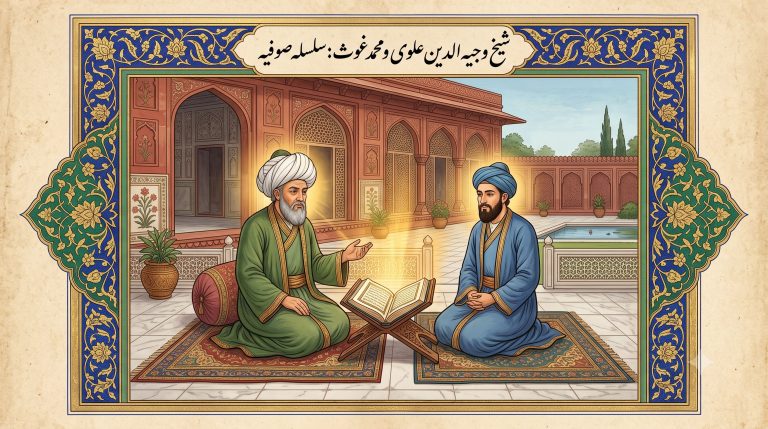
Sheikh Wajihuddin Alavi’s intellectual legacy
Sheikh Wajihuddin Alavi Gujrati was remembered not only as a Sufi guide and teacher, but as a scholar who wrote across Qur’anic interpretation, hadith, law, logic, language and spirituality. A circulated list attributes 79 books and commentaries to him. The most careful way to present that claim is to begin with the catalogue in Mohammad Khalid’s 2011 doctoral thesis and to distinguish works the researcher could locate from titles known only through earlier records.
That gives 67 catalogue entries in the thesis section inspected for this article. This number is more defensible than treating every line in the circulated 79-item list as a separate surviving book. That larger list contains repetitions, alternative forms and damaged transliterations. It may also combine material from other inventories.
The phrases before the list are honorifics. Titles such as Qutb al-‘Ulama, Ustad al-Hind, ‘Ali Thani and Badr al-‘Urafa praise Sheikh Wajihuddin’s standing. They should not be counted as names of books.
Why so many works are commentaries
Many titles begin with hashiyah, meaning a scholarly gloss or marginal commentary. In the manuscript culture of Sheikh Wajihuddin’s time, a hashiyah was a serious form of scholarship. It could clarify difficult language, test an argument, compare authorities and guide advanced students through a standard text.
The catalogue therefore reflects the life of a teacher. A commentary on al-Baydawi belongs to the study of tafsir; a work connected with Nuzhat al-Nazar belongs to hadith methodology; titles on al-Talwih, Ibn al-Hajib and inheritance concern law and its principles. Other works engage logic, theology, grammar, rhetoric and Sufi teaching.
The 23 works located in the 2011 study
Khalid states that this group comprised nineteen Arabic works and four Persian works. The descriptions record the research situation in 2011; they do not prove that every manuscript remains at the same institution today. Romanized titles below are reading aids rather than a new critical edition.
Arabic works located or described (19)
- Hashiyah ‘ala Tafsir al-Baydawi
- Risalah fi al-Tafsir (also called al-Risalah al-‘Alawiyyah)
- Sharh Nuzhat al-Nazar fi Sharh Nukhbat al-Fikr
- Hashiyah ‘ala Sharh al-Wiqayah
- Risalah fi al-Fiqh (Tartib fi al-Salah)
- Sharh al-Basit fi al-Fara’id
- Hashiyah ‘ala Sharh al-Jami
- Sharh al-Irshad
- Hashiyah ‘ala Hashiyat al-Qushji ‘ala al-Mutawwal
- Hashiyah ‘ala al-Talwih
- Hashiyah ‘ala al-Wafiyah Sharh al-Kafiyah
- Sharh Shawahid al-Manhal al-Safi fi Sharh al-Wafi lil-Balkhi
- Hashiyah ‘ala al-Dariri
- Hashiyah ‘ala al-Mukhtasar al-Ma‘ani
- Hashiyah Sharh al-Mawaqif
- Hawashi ‘ala al-Muhassal al-‘Alawi
- Risalah Haqiqat Muhammadiyyah
- Hashiyah ‘Aqa’idiyyah
- Risalah Mukhtasar Mawlawi al-Jazari
Persian works located or described (4)
- Sharh-i Jam-i Jahan-numa
- Sharh bar Risalah-yi Mulla ‘Ali Qushchi
- Malfuzat-i Shaykh Wajih al-Din ‘Alawi
- Awrad-i Shaykh Wajih al-Din ‘Alawi Gujarati
What these surviving records reveal
Qur’anic interpretation
The commentaries associated with al-Baydawi and the Risalah fi al-Tafsir place Sheikh Wajihuddin within a tradition of close reading and explanation. A commentary is not the base work itself: al-Baydawi wrote the tafsir, while Sheikh Wajihuddin is associated with a gloss upon it.
Hadith and law
The catalogue includes a commentary related to Nuzhat al-Nazar and Nukhbat al-Fikr, texts associated with Ibn Hajar’s hadith methodology. Legal works address prayer, inheritance and the principles of jurisprudence. Their range helps explain why later accounts remember Wajihuddin as both a spiritual teacher and an accomplished scholar.
Logic, theology and language
Works on al-Mawaqif, al-Qushji, al-Jami and other instructional texts belong to the advanced curriculum of the period. These titles illuminate the intellectual world of the Ahmedabad madrasa more reliably than a simple total alone.
Tasawwuf and devotional life
Haqiqat Muhammadiyyah, the Awrad and the recorded Malfuzat bring spiritual teaching into the catalogue. An awrad collection preserves regular devotions; malfuzat records sayings and conversations. Neither label by itself proves that a surviving manuscript is in the author’s own hand.
Additional titles recorded without a located copy
The thesis separately lists the following titles for which the researcher had not located manuscripts. “Unlocated” does not mean that a work never existed, and it does not mean that a copy cannot later be found. It means the title should not be advertised as presently available without a current catalogue record.
View the 44 additional catalogue entries
- Risalah Jannat ‘Adan ‘ala Tafsir al-Baydawi
- Risalah wa-alladhina amanu wa-tatba‘at-hum dhurriyyatuhum bi-iman
- Hashiyah ‘ala Tafsir al-Rahmani
- Hashiyah Hidayah
- Hashiyah ‘Aqa’idiyyah
- Sharh Wajiz
- Hashiyah Usul al-Bazdawi
- Hashiyah ‘ala Sharh al-Tajrid
- Hashiyah ‘ala Sharh al-‘Aqa’id
- Hashiyah bar Hashiyah-yi Qadimah
- Risalah al-Kalam
- Hashiyah ‘ala Hashiyat al-Khayali
- Sharh Hikmat al-‘Ayn
- Sharh Abyat Manhal al-Damamini
- Sharh Abyat al-Tashil
- Hashiyah Sharh Mukhtasar fi al-Usul li-Ibn al-Hajib
- Hashiyah Kafiyah fi al-Nahw
- Hashiyah ‘ala Sharhayn li-l-Miftah fi ‘Ilm al-Ma‘ani wa-l-Bayan
- Sharh Risalah Shamsiyyah fi al-Mantiq
- Hashiyah Tahdhib al-Mantiq
- Hashiyah Qutbi
- Hashiyah Sharh Matali‘ al-Anwar
- Hashiyah Jalaliyyah
- Hashiyah Sharh Chaghmini
- Risalah Iman
- Risalah Tariqah-yi Bay‘at
- Sharh-i Kalid-i Makhzan
- Sharh-i Lawa’ih-i Jami
- Maktubat
- Hashiyah Kashf al-Usul
- Hashiyah Shifa-yi Qadi ‘Iyad
- Hashiyah Isfahani
- Hashiyah ‘ala Manhal al-‘Allamah al-Jami
- Sharh Tuhfah-yi Shahiyyah
- Hashiyah Zubdah
- Hashiyah ‘Ayn al-Miftah
- Hashiyah ‘ala al-Sharh Tadhkirah-yi Nishapuri
- Risalah al-Qalb
- Risalah Waqf A‘dad
- Risalah fi Tahqiq Iblis
- Hashiyah ‘ala Kitab al-Sayyid Sharif al-Jurjani
- Risalah fi al-Ajwibah ‘an al-I‘tiradat al-Fiqhiyyah … ‘ala Fadil al-Hindi
- Hashiyah Sharh al-Maqasid
- Mukhtasar Talkhis
How the circulated 79-item list should be used
The circulated list is valuable as a lead for further research, but it should not be published as 79 independently verified books. It repeats Risalah fi Mas’alat al-Takfir, separates variant forms that may describe the same work, and contains spellings that make the underlying Arabic or Persian title uncertain. Some entries also need clearer separation between a base text, its commentary and a gloss on that commentary.
A responsible digital catalogue should add four fields to every title: the original-script title, subject, manuscript library and shelfmark, and the source that attributes it to Sheikh Wajihuddin. Where a scan exists, its opening folio and colophon should be checked. This work can gradually turn a devotional list into a useful scholarly finding aid.
A lasting scholarly legacy: the importance of this catalogue lies in its breadth and in the teaching culture it represents. Sheikh Wajihuddin’s intellectual life joined rigorous textual study with spiritual formation. Preserving accurate titles, manuscript evidence and source distinctions is itself a form of service to that legacy.
Sources
- Mohammad Khalid, Life and Works of Sheikh Wajihuddin Alavi Gujrati, PhD thesis, Department of Arabic, Aligarh Muslim University, 2011, printed pp. 257–260 (PDF pp. 294–297). The original page images were inspected for the division between located and unlocated works.
- Khalid, printed pp. 269 onward (PDF pp. 306 onward), for his discussion of selected works and manuscript descriptions. Individual manuscript claims require their own catalogue verification.
- Mustafa Husain Alvi, The Sun in a Candle: Life and Teachings of Hazrat Shah Wajeehuddin Alvi, English edition consulted, especially pp. 47 and 83. Its estimates and family recollections are read alongside the thesis rather than treated as a separate manuscript census.
Editorial note: transliteration has been regularized for readability. Where the thesis scan or the circulated English list remains ambiguous, the title is provisional. Readers with manuscript evidence or a library shelfmark are invited to share it with Al-Hashmi for a future verified catalogue.