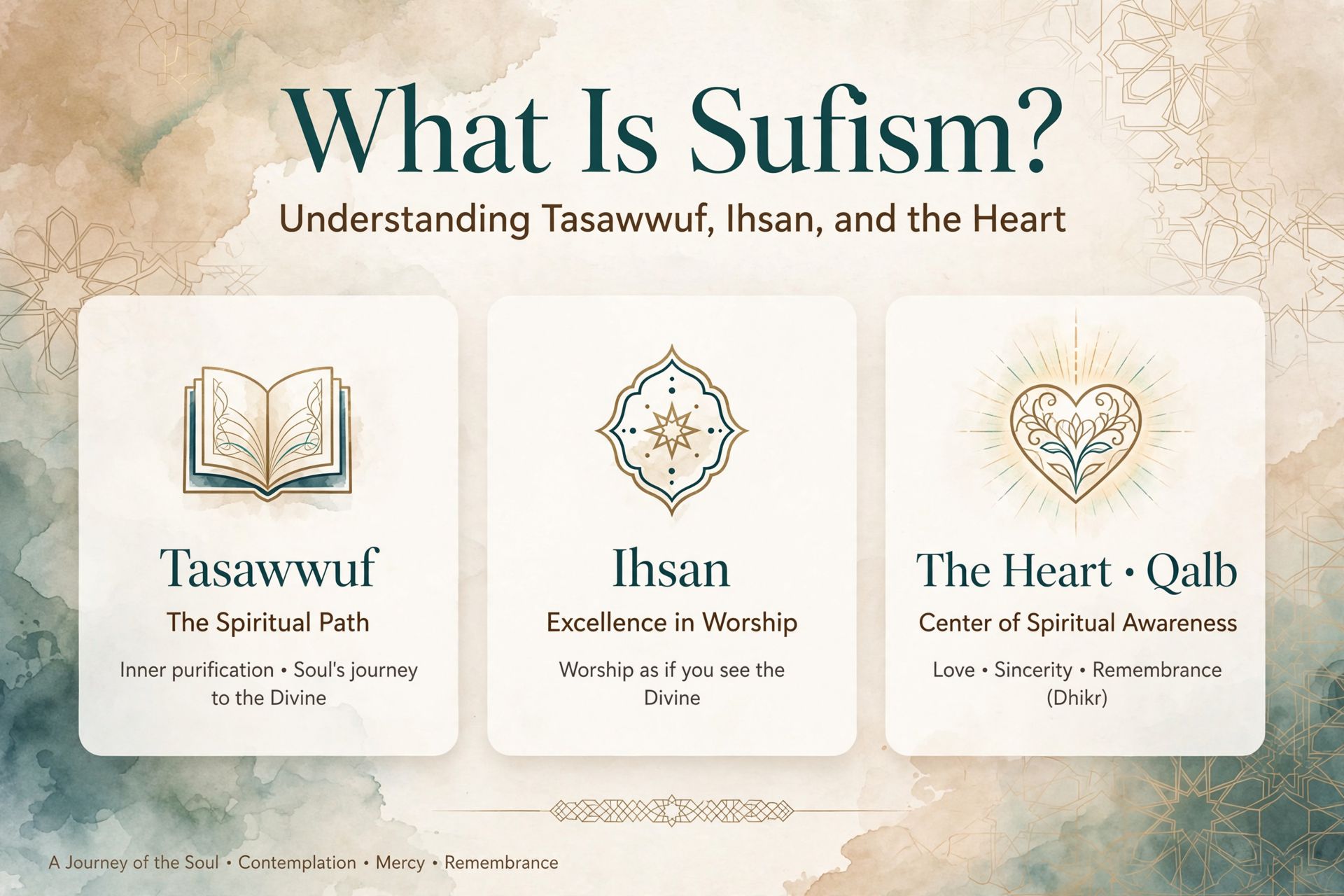
Sufism, commonly called tasawwuf, is a tradition of Islamic spiritual education concerned with sincerity, remembrance of Allah and the cultivation of good character. This beginner’s guide approaches it through worship, self-examination and everyday responsibilities: how we pray, speak, work and treat other people.
For someone encountering Islamic spirituality for the first time, unfamiliar terms can make the subject feel distant. Yet its practical questions are close to home. Can I listen without interrupting? Can I serve without seeking praise? Can I bring more attention to a prayer I already perform?
Egypt’s Dar al-Ifta describes tasawwuf as spiritual development directed toward ihsan, with the Qur’an and Sunnah as its foundation. This article uses that approach while distinguishing scriptural teachings from the practical reflections offered below. Read Dar al-Ifta’s explanation of Sufism.
What does tasawwuf mean?
Tasawwuf is the Arabic term commonly used for Sufism. In the approach followed here, it concerns the education of the heart: examining motives, correcting harmful habits and growing in attentiveness to Allah. “Heart” describes the inward life of intention and moral awareness.
Several related terms help make this subject easier to understand. They overlap, but each directs attention to a particular part of spiritual learning.
| Term | Meaning in this guide | Everyday reflection |
|---|---|---|
| Ihsan | Excellence in worship, with awareness of Allah | Pay attention to the words of prayer. |
| Tazkiyah al-nafs | Purification and cultivation of the self | Recognise a harmful habit and work to change it. |
| Dhikr | Remembrance of Allah | Learn the meaning of a familiar remembrance. |
| Niyyah | Intention behind an action | Ask why you are undertaking a responsibility. |
| Ikhlas | Sincerity toward Allah | Do useful work without depending on praise. |
| Adab | Good manners and fitting conduct | Listen carefully and disagree respectfully. |
| Muhasabah | Self-examination | Review one action and identify a needed correction. |
| Suhbah | Companionship | Spend time with people who encourage learning and responsibility. |
How does Sufism relate to Islam?
Dar al-Ifta presents tasawwuf as a discipline within Islamic religious life and insists that its teachings remain consistent with the Qur’an and Sunnah. This is the framework used here; it should not be read as an endorsement of every practice associated with the name Sufism.
A useful starting point is the hadith of Jibril, which discusses Islam, iman and ihsan together. Its treatment of religious practice, faith and excellence in worship helps readers understand why inward attention matters alongside outward action. Sahih Muslim 8a.
For a beginner, this relationship gives learning a practical direction. Study the worship you perform, understand your responsibilities and consider the attitude you bring to them. A growing interest in spirituality should also prompt careful attention to ordinary commitments.
What is ihsan in Sufism?
Ihsan concerns excellence in worship through awareness of Allah. In the hadith of Jibril, the Prophet Muhammad (peace and blessings be upon him) explains it through worshipping with profound awareness of Allah and knowing that Allah sees the worshipper. This is a paraphrase of Sahih Muslim 8a.
One practical reflection is to choose a phrase from your prayer and study its meaning. When you recite it, return your attention to what you are saying. If your mind wanders, notice that gently and return again.
The same question of attention can accompany daily work: have I carried out this task carefully? Have I given someone the consideration I would hope to receive? These examples illustrate a way to reflect on conduct; they are not additional definitions attributed to the hadith.
What is tazkiyah al-nafs?
Tazkiyah al-nafs means purification and cultivation of the self. Surah Ash-Shams connects success with purification of the soul, providing a scriptural foundation for reflection on moral and spiritual growth. Qur’an 91:9.
Self-purification becomes easier to understand when connected to a specific habit. Consider someone who frequently interrupts. The behaviour may reveal impatience, insecurity or a desire to be admired. Recognising the pattern makes a concrete response possible: let the other person finish, ask a thoughtful question and resist taking over the conversation.
This kind of muhasabah, or self-examination, can begin with three questions:
- What did I do, and who was affected?
- What motive or habit may have contributed?
- What correction can I make now?
The purpose of this exercise is to support responsibility. If you spoke unfairly, offer an apology. If you neglected a promise, make a realistic arrangement to fulfil it. Reflection becomes useful when it leads to a change someone can actually experience.
What is dhikr, and how can a beginner approach it?
Dhikr means remembrance of Allah. The Qur’an calls believers to remember Allah abundantly in Surah Al-Ahzab. This invitation helps explain the importance of remembrance in Islamic spiritual life. Qur’an 33:41.
A useful beginning is to learn the meanings of words already present in your worship. Familiar phrases include subhan Allah, expressing Allah’s transcendence; alhamdulillah, expressing praise of Allah; and Allahu akbar, expressing Allah’s greatness.
Ask a knowledgeable teacher about established remembrances and their context. Give attention to understanding and consistency. This guide does not prescribe a particular count, special formula or order-specific devotional routine.
After a moment of remembrance, consider the responsibility immediately before you. Perhaps someone is waiting for an answer, a family member needs help or work needs finishing. This is a practical invitation to connect reflection with attentive living.
Niyyah and ikhlas: why do intentions matter?
Niyyah is intention; ikhlas concerns sincerity toward Allah. The opening hadith of Sahih al-Bukhari connects actions with intentions, inviting attention to the purpose behind what we do. Sahih al-Bukhari 1.
Imagine helping organise a community lesson. You may want people to benefit and also hope they recognise your effort. Motives can be mixed. Honest reflection allows you to acknowledge that mixture and renew your purpose while continuing the useful work.
Before a task, ask what good you intend. During it, notice whether concern for your image is changing your behaviour. Afterwards, consider whether you fulfilled the responsibility well. These are reflective prompts, not a prescribed ritual.
Adab in Sufism: learning through good manners
Adab concerns good manners and conduct appropriate to a relationship or situation. In a learning setting, it can be practised through preparation, careful listening, honest questions and respect for other people’s time.
For example, a student can disagree with an explanation while asking for clarification courteously. A teacher can correct an error without humiliating the learner. A discussion becomes more useful when its participants care about understanding as well as speaking.
To explore this subject further, read our guide to adab in Sufism and good manners.
Humility and service in everyday life
Humility can be practised by admitting uncertainty, accepting a fair correction or recognising another person’s contribution. Service can begin with an ordinary need: help a student understand a lesson, visit someone who feels forgotten or complete a shared task reliably.
A helpful question is: what does this person actually need from me? Sometimes the answer is practical assistance. Sometimes it is patient attention. Asking first can prevent well-intentioned help from becoming an opportunity to display our own importance.
For related reading, explore Sheikh Wajihuddin Alavi’s remembrance, humility and service. Readers seeking biographical context can also visit our introduction to Sheikh Wajihuddin Alavi Gujrati.
Learning with a teacher and good company
Dar al-Ifta’s explanation gives a role to qualified spiritual teachers and describes Sufi orders as settings for spiritual training. Readers may encounter the words shaykh for a teacher and tariqah for a spiritual path or order.
When considering instruction, take time to ask about the teacher’s learning, the sources used and how questions are handled. Clear explanations and responsible conduct are useful things to look for. Respect for a teacher can coexist with careful judgment and appropriate personal boundaries.
Suhbah, or companionship, also invites reflection on the company you keep. Notice which relationships encourage patience, honesty and study. A regular opportunity to learn with thoughtful people can help turn a vague interest into a sustainable habit.
How can a beginner start learning tasawwuf?
Begin with reliable instruction, understanding your worship and one manageable improvement in conduct. The following sequence is an educational suggestion for readers, not a transmitted Sufi practice or formal initiation programme.
- Choose a clear learning question. Start with a term such as ihsan or the meaning of a phrase in prayer.
- Read its source in context. Follow the Qur’an and hadith references below and seek help where interpretation is unclear.
- Identify one habit to improve. Choose something observable, such as interrupting, delaying a promise or speaking harshly.
- Practise one useful response. Listen fully, honour the commitment or pause before replying.
- Review and seek guidance. Notice what changed, acknowledge mistakes and bring genuine questions to a qualified teacher.
A simple daily reflection
Before your day’s responsibilities, identify one good intention. During worship, attend to a meaning you have studied. In a conversation, practise patient listening. At the end of the day, recall one thing you did well and one thing that needs repair.
Keep the reflection brief enough to sustain. If you discover an apology is needed, make it. If a question requires study, write it down. Progress in this exercise means becoming more attentive and responsible in specific situations.
Frequently asked questions about Sufism and tasawwuf
Are Sufism and tasawwuf the same?
Tasawwuf is the Arabic term commonly used for Sufism. This guide uses both terms for Islamic spiritual education concerned with sincerity, remembrance and character.
What is the difference between tasawwuf and tazkiyah?
Tazkiyah refers to purification and cultivation of the self. Tasawwuf is a broader term for the spiritual teaching and discipline discussed here, within which self-purification is an important concern.
Is ihsan mentioned in hadith?
Yes. The hadith of Jibril discusses ihsan alongside Islam and iman. It connects excellence in worship with awareness of Allah. Read the narration in Sahih Muslim 8a.
What does purification of the heart mean in practical terms?
In this guide, it means examining intentions and working on harmful habits such as arrogance, dishonesty or the need for praise. A practical example is recognising unfair speech, apologising and changing how you respond.
Does a beginner need a special dhikr formula?
This introduction recommends understanding the remembrances already present in worship and seeking reliable instruction. It does not assign a special formula or count. Questions about particular devotional routines should be taken to a qualified teacher.
Can I start learning before joining a Sufi order?
You can begin with the introductory sources, vocabulary and practical reflections in this guide. A formal relationship with an order involves further questions about its instruction and expectations, which deserve informed discussion.
Where should I read next?
Continue with adab and good manners, then explore remembrance, humility and service. Choose one idea from your reading to consider in an everyday responsibility.
Sources and reading note
- Egypt’s Dar al-Ifta: Sufism — a manual for spiritual growth? Institutional explanation of tasawwuf and spiritual instruction.
- Sahih Muslim 8a: the hadith of Jibril on Islam, iman and ihsan.
- Qur’an 91:9: purification of the soul.
- Qur’an 33:41: remembrance of Allah.
- Sahih al-Bukhari 1: actions and intentions.
Reading note: Scriptural teachings above are paraphrased. Everyday examples, reflection questions and the suggested learning sequence are editorial illustrations, not quotations from a historical Sufi teacher or prescribed devotional practices.