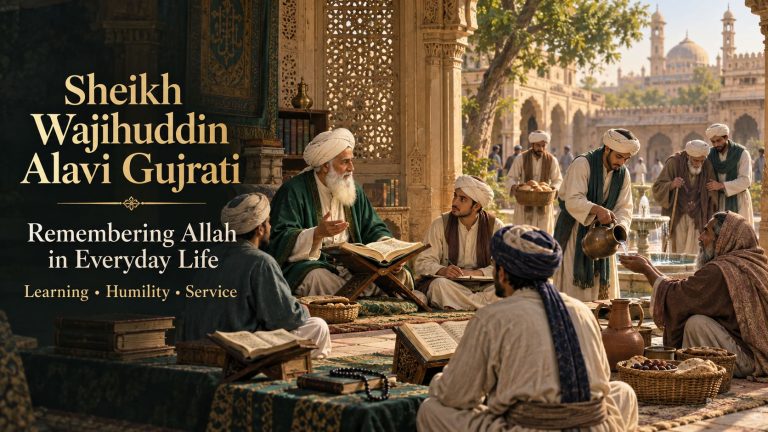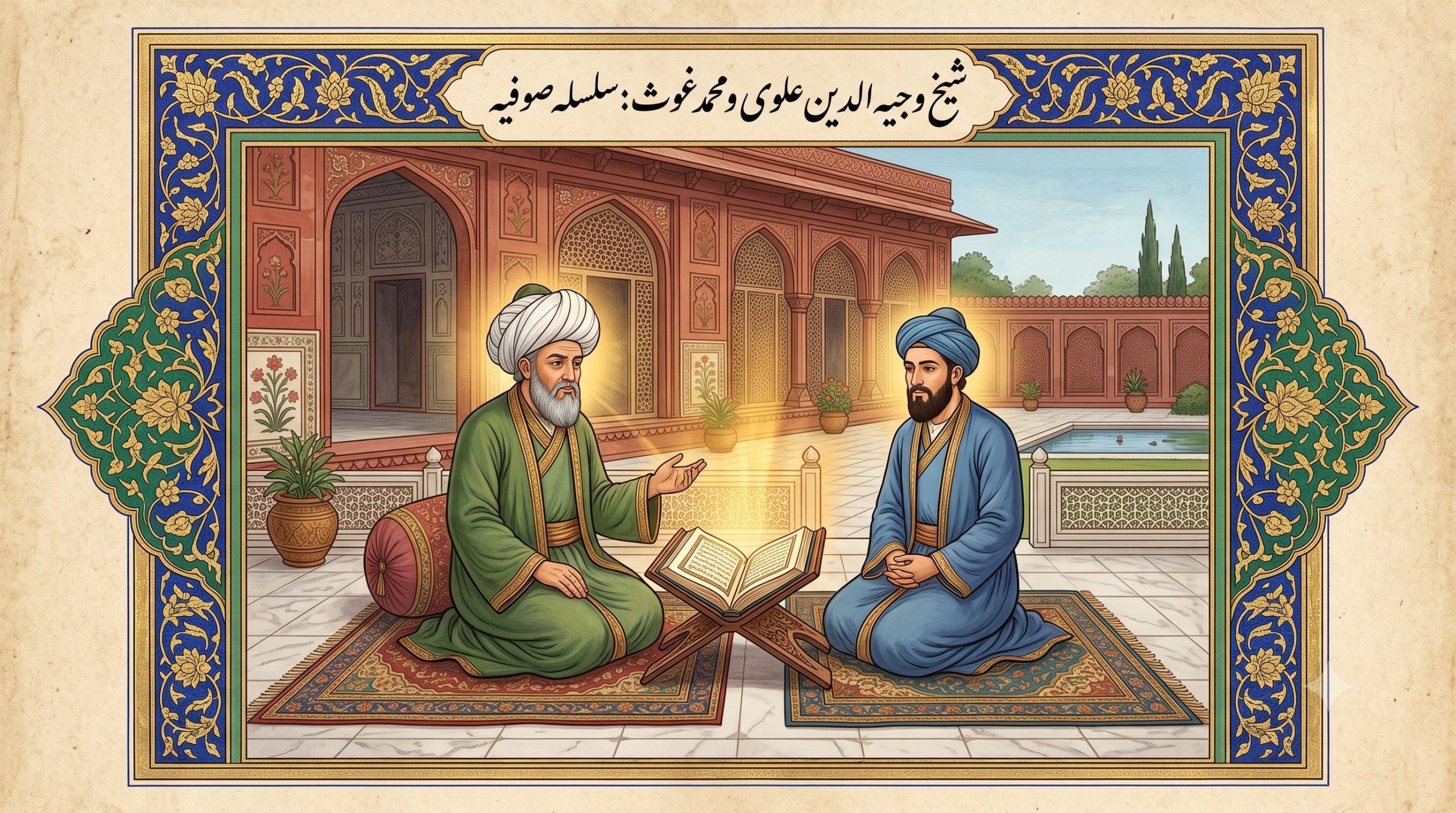
Sheikh Wajihuddin Alavi and Muhammad Ghawth: Spiritual Lineage, Initiation and Authorization
Sheikh Wajihuddin Alavi Gujrati was a disciple of Muhammad Ghawth of Gwalior, according to the biographical evidence examined in Mohammad Khalid’s doctoral thesis. Khalid describes their meeting, Wajihuddin’s initiation through bay‘ah, the spiritual benefit he received through companionship, and the authorization or khilafah transmitted through this relationship. The thesis also records earlier teachers and other affiliations, showing that Wajihuddin’s spiritual formation developed through several relationships rather than a single isolated event. [1]
The relationship between Sheikh Wajihuddin Alavi and Muhammad Ghawth is important for understanding the history of the Shuttari Sufi tradition in Gujarat. It also helps explain how spiritual training, formal Islamic scholarship and the work of educating students came together in Wajihuddin’s life.
Sheikh Wajihuddin Alavi and Muhammad Ghawth: the relationship at a glance
Muhammad Ghawth holds a prominent place in Sheikh Wajihuddin Alavi Gujrati’s spiritual biography. The evidence assembled by Khalid presents Muhammad Ghawth as a guide from whom Wajihuddin received initiation, companionship and authorization. Yet it also places this relationship within a longer history of instruction under his father and other spiritual teachers.
| Person or term | Place in the account | Why it matters |
|---|---|---|
| Sheikh Wajihuddin Alavi Gujrati | Scholar, seeker, disciple and later spiritual teacher | His life connects formal education with Sufi discipline |
| Muhammad Ghawth of Gwalior | Prominent spiritual guide in Wajihuddin’s biography | The relationship is central to Wajihuddin’s Shuttari association |
| Bay‘ah | Initiatory pledge within a guide–disciple relationship | Marks formal entry into a spiritual path or bond |
| Khilafah | Authorization or succession granted by a spiritual guide | Concerns permission and responsibility, not merely attendance |
| Suhbah | Transformative companionship with a teacher | Shows that Sufi learning was transmitted through conduct as well as words |
| Shuttari affiliation | Association emphasized through Muhammad Ghawth | Places Wajihuddin within a wider South Asian spiritual network |
Wajihuddin’s spiritual teachers before Muhammad Ghawth
Khalid begins his account of Sheikh Wajihuddin’s spiritual formation with instruction under his father. The thesis then describes a connection with Shah Qazin, whom it places in a Chishti setting. Badruddin Abul Qasim and Sayyid Kabiruddin also appear in the sequence of formative relationships. [1]
This order of events matters. Muhammad Ghawth did not enter a life without earlier spiritual education. By the time their relationship began, Wajihuddin had already experienced family instruction, association with teachers and disciplined religious practice. The biography therefore presents spiritual formation as cumulative: guidance received at one stage prepared the student for what followed.
Mustafa Husain Alvi’s English biography, The Sun in a Candle, also remembers instruction under Wajihuddin’s father and other guides. Alvi’s account helps prevent a misleading “before and after” narrative in which the meeting with Muhammad Ghawth erases everything that came earlier. It was a decisive development, but it belonged to a longer journey. [4]
Why several teachers were not unusual
In a premodern Islamic scholarly setting, a student could learn different disciplines from different teachers. Spiritual affiliation could likewise include several layers: early instruction, devotional practice, companionship, initiation and later authorization did not necessarily come from the same person. Recognizing these distinctions produces a more accurate picture than treating every named teacher as if each had performed an identical role.
The meeting with Muhammad Ghawth in Gujarat
Khalid reports that when Muhammad Ghawth of Gwalior came to Gujarat, Sheikh Wajihuddin sought him out and entered a relationship of discipleship. The narrative describes Wajihuddin receiving spiritual benefit through Muhammad Ghawth’s company and then receiving authorization through him. [1]
This account presents companionship as a form of education. A spiritual guide taught not only through formal statements but through presence, example, correction and sustained practice. The relationship was therefore more than attending a lecture. It involved a bond between guide and disciple through which spiritual discipline was learned and transmitted.
Mustafa Husain Alvi emphasizes the affection and commitment within this relationship. In his presentation, Muhammad Ghawth’s companionship became an important part of Wajihuddin’s development and helped connect personal spiritual guidance with his later work of teaching and serving students. [4]
Was Wajihuddin Alavi a disciple of Muhammad Ghawth?
Yes. The sources assembled by Khalid describe Sheikh Wajihuddin as attached to Muhammad Ghawth through discipleship and authorization. A recent academic article published by the University of the Punjab also identifies Shah Wajeehuddin Alvi Gujrati as a disciple of Shah Muhammad Ghawth Gwaliyari. [5] The precise vocabulary used by individual historical witnesses still needs to be preserved, because initiation, companionship and succession describe related but distinct aspects of the relationship.
What do bay‘ah, khilafah and ijazah mean in this account?
Three terms frequently appear in discussions of Sufi spiritual lineage. They should not be used as if they were interchangeable.
- Bay‘ah
- A pledge or initiation through which a seeker formally enters a spiritual relationship with a guide. In this context, it identifies Wajihuddin as more than a visitor to Muhammad Ghawth’s gathering.
- Ijazah
- Permission granted by a qualified teacher. Depending on the source and context, it may refer to permission to transmit a text, teach a discipline, perform a practice or guide others.
- Khilafah
- Authorization or succession within a spiritual relationship. It normally implies entrusted responsibility, although its exact scope must be determined from the wording of the relevant authorization.
- Suhbah
- Companionship with a teacher. In Sufi biography, this can describe the formative influence received through spending time with a guide and observing his conduct.
- Silsila
- A chain of spiritual transmission linking teachers and disciples across generations.
The distinctions protect the historical meaning of the relationship. A person might hear lessons from a teacher without taking bay‘ah, take bay‘ah without receiving khilafah, or receive authorization limited to a particular practice. For this reason, the wording preserved by each source deserves attention.
What historical sources describe the relationship?
Khalid’s thesis is especially useful because it does not rely on only one later biography. It brings several testimonies into conversation. These witnesses were written in different contexts and do not all emphasize the same aspect of Sheikh Wajihuddin’s spiritual identity.
| Historical witness | Work | Contribution to the account |
|---|---|---|
| Ghulam Ali Azad Bilgrami | Subhat al-Marjan | Cited by Khalid in support of Wajihuddin’s relationship with Muhammad Ghawth |
| Abd al-Qadir Bada’uni | Muntakhab al-Tawarikh | Attributes an important part of Wajihuddin’s spiritual formation to Muhammad Ghawth |
| Abd al-Haqq Dihlawi | Akhbar al-Akhyar | Describes attachment to Muhammad Ghawth while also referring to Qadiri affiliation and devotional practice |
| Emperor Jahangir | Memoirs | Remembers Wajihuddin as a distinguished successor of Muhammad Ghawth |
| Sayyid Husayni Pir Alavi | Later transmitted account | Provides the channel through which Khalid reproduces a reported authorization text |
These works are cited here through Khalid’s thesis unless otherwise stated. They have not all been independently consulted for this article. That limitation does not make them unusable, but it changes how confidently their wording can be described. “Khalid quotes Bada’uni as saying” is more precise than implying direct verification from a manuscript or critical edition.
The reported authorization text
Khalid reproduces a text of authorization through the account of Sayyid Husayni Pir Alavi. This adds a documentary strand to the biographical testimonies. Nevertheless, it should be described accurately as a text transmitted through the cited source—not as an original authorization document personally inspected or authenticated for this article. [2]
This careful wording is not merely academic caution. It helps readers understand the difference between an original document, a copy, a quotation and a later report of a text. Each can preserve valuable information, but they are not the same type of evidence.
Was Sheikh Wajihuddin Alavi Shuttari or Qadiri?
Sheikh Wajihuddin is prominently associated with the Shuttari tradition through Muhammad Ghawth, while some historical testimony also refers to a Qadiri affiliation and devotional practice. These descriptions need not be forced into a simple either-or choice.
Khalid’s quotation from Abd al-Haqq Dihlawi describes Wajihuddin’s attachment to Muhammad Ghawth while also preserving the Qadiri reference. Jahangir’s testimony, as quoted in the thesis, emphasizes Wajihuddin’s position as a successor of Muhammad Ghawth. Other modern summaries use expressions such as “Shuttari,” “Qadiri–Shuttari” or describe an earlier Qadiri affiliation followed by Shuttari initiation. [2]
The safest conclusion is therefore specific: Muhammad Ghawth was a major spiritual guide in Wajihuddin’s life, and the relationship is fundamental to his Shuttari association. References to other affiliations should be retained where the sources record them rather than erased to create a cleaner but less accurate lineage.
Affiliation is not the same as exclusivity
Modern readers often assume that belonging to one Sufi order automatically excludes every other devotional connection. Premodern biographies can be more complex. A scholar might receive practices, initiation or authorization through more than one chain, and later authors might emphasize different relationships depending on their purpose. The task of the historian is to identify what each testimony actually claims.
How did spiritual training shape Wajihuddin Alavi’s teaching?
Immediately after discussing Wajihuddin’s spiritual relationships, Khalid turns to his educational activity in Ahmedabad. The thesis describes a madrasa in which Qur’anic interpretation, hadith, jurisprudence, literature, logic, philosophy, mathematics and astronomy appeared alongside spiritual guidance and practical attention to students’ needs. [3]
This arrangement provides an important interpretive clue. The relationship with Muhammad Ghawth was not an isolated devotional episode; it belonged to the formation of a scholar who would guide others. Spiritual companionship helped shape a teaching life characterized by study, practice, mentorship and service.
Wajihuddin’s concern for accommodation, financial support and medical care for students strengthens this connection. Spiritual formation found expression in the conditions he created for learning. His model joined knowledge of texts with responsibility toward the people studying them.
The relationship between teacher and disciple also helps explain why later sources cared about authorization. In an educational and spiritual culture built on transmission, the question was not simply what a person knew, but from whom it had been learned and whether permission had been given to pass it onward.
Why this relationship matters in Sufi history
The connection between Sheikh Wajihuddin Alavi and Muhammad Ghawth matters for at least four reasons:
- It explains Wajihuddin’s prominent Shuttari association. The initiation and authorization described by Khalid connect him to one of the important spiritual networks of early modern South Asia.
- It demonstrates how spiritual knowledge was transmitted. Bay‘ah, companionship and khilafah describe different stages or dimensions of the guide–disciple relationship.
- It connects Gujarat with wider centres of learning. Muhammad Ghawth’s presence in Wajihuddin’s biography places Ahmedabad and Champaner within a network extending beyond Gujarat.
- It illuminates Wajihuddin’s later work as a teacher. The man who received instruction and authorization became responsible for educating and caring for students himself.
The relationship also teaches a sound method for reading Sufi biography. We should ask who is speaking, how close the author was to the events, what kind of relationship is being described, and whether a document survives independently or only through quotation. Preserving those distinctions gives readers a richer and more trustworthy history.
Frequently asked questions
Who was Sheikh Wajihuddin Alavi’s spiritual teacher?
Muhammad Ghawth of Gwalior was one of Sheikh Wajihuddin Alavi’s most prominent spiritual teachers. Mohammad Khalid’s thesis describes Wajihuddin seeking him out in Gujarat, entering discipleship, benefiting from his companionship and receiving authorization. Wajihuddin had also received earlier instruction from his father and other guides.
Was Wajihuddin Alavi a disciple of Muhammad Ghawth?
Yes. The testimonies assembled in Khalid’s thesis describe a guide–disciple relationship involving initiation, companionship and authorization. A 2023 University of the Punjab journal article also identifies Wajihuddin as a disciple of Muhammad Ghawth Gwaliyari.
How did Sheikh Wajihuddin meet Muhammad Ghawth?
Khalid reports that when Muhammad Ghawth came to Gujarat, Wajihuddin sought him out and entered his company. The thesis then describes spiritual benefit, initiation and authorization through this relationship.
Did Muhammad Ghawth give khilafah to Wajihuddin Alavi?
Khalid’s thesis reports authorization through Muhammad Ghawth and reproduces an authorization text through a later source. The text should be described as transmitted evidence rather than an independently authenticated original examined for this article.
What does bay‘ah mean in Sufism?
Bay‘ah is an initiatory pledge through which a seeker enters a formal spiritual relationship with a guide. It is more specific than attending a lesson or visiting a teacher.
What is the difference between bay‘ah and khilafah?
Bay‘ah begins or formalizes the guide–disciple relationship, while khilafah concerns authorization or succession entrusted by the guide. A disciple may take bay‘ah without necessarily receiving khilafah.
Was Sheikh Wajihuddin Alavi Shuttari or Qadiri?
He is prominently associated with the Shuttari tradition through Muhammad Ghawth, but historical testimony quoted by Khalid also refers to a Qadiri affiliation and devotional practice. These layered relationships should be preserved rather than reduced to an unsupported either-or answer.
Who taught Wajihuddin Alavi before Muhammad Ghawth?
Khalid begins with instruction under Wajihuddin’s father and then names Shah Qazin, Badruddin Abul Qasim and Sayyid Kabiruddin among the earlier formative relationships.
Which historical sources mention their relationship?
Khalid cites or quotes Ghulam Ali Azad Bilgrami’s Subhat al-Marjan, Bada’uni’s Muntakhab al-Tawarikh, Abd al-Haqq Dihlawi’s Akhbar al-Akhyar, Jahangir’s memoirs and a reported authorization text transmitted through Sayyid Husayni Pir Alavi.
Why was Muhammad Ghawth important to Wajihuddin Alavi’s legacy?
Muhammad Ghawth’s guidance helps explain Wajihuddin’s Shuttari association and the spiritual authority later sources attributed to him. The relationship also connects Wajihuddin’s personal formation with his subsequent work as a teacher and guide in Ahmedabad.
Sources and further reading
Principal source: Mohammad Khalid, Life and Works of Sheikh Wajihuddin Alavi Gujrati, PhD thesis in Arabic, Aligarh Muslim University, 2011.
- Khalid, printed pp. 212–213; supplied PDF pp. 249–250. Earlier authors named in this section are quoted through Khalid.
- Khalid, printed pp. 214–215; supplied PDF pp. 251–252. The reported authorization text should be distinguished from an independently authenticated original.
- Khalid, printed pp. 215–218; supplied PDF pp. 252–255.
- Mustafa Husain Alvi, The Sun in a Candle: Life and Teachings of Hazrat Shah Wajeehuddin Alvi, supplied undated PDF, pp. 56–59 and 62. Page 59 records earlier training and qualifies the simplified turning-point language on p. 56. The spelling “Shah Qazin” appears on p. 34.
- Ihsan Ahmad and Muhammad Zaheer Baber, “Life History, Spiritual and Educational Services of Shah Wajeehuddin Alvi Gujrati,” Oriental College Magazine, vol. 98, no. 3, 2023, pp. 31–48, University of the Punjab abstract.