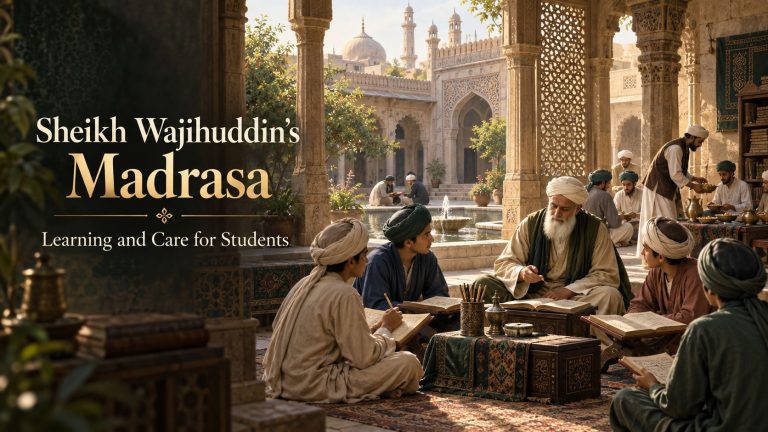
Religious learning reaches people through language. Mustafa Husain Alvi’s biography remembers Sheikh Wajihuddin Alavi Gujrati as speaking in Gujri as well as Persian and Arabic, using different languages for different listeners in the classroom and beyond it. [1]
This short passage does not settle the complete linguistic history of early Gujarati, Gujri, Dakhni, or Urdu. It does, however, preserve an important educational idea: a teacher may possess advanced scholarship while still choosing words that ordinary listeners can understand.
Persian, Arabic, and the local audience
Alvi describes Persian as the language associated with government, nobles, and scholars in Wajihuddin’s period. Arabic remained central to religious texts and higher study. Alongside them, the biography presents Gujri as a widely understood regional form of speech used by Sufis for memorable teaching. [1]
The terminology deserves care. Modern labels for Gujarati, Gujri, Dakhni, and Urdu do not always map neatly onto sixteenth-century usage. Alvi was writing an English devotional biography centuries later, and his brief explanation should be compared with specialist histories of language before it becomes a precise linguistic chronology.
For the biography’s educational portrait, the central point is clearer. Sheikh Wajihuddin is represented as moving between learned and accessible registers. Persian and Arabic connected his circle with scholarly literature. Gujri helped spoken guidance reach people outside a narrow scholarly group.
The classroom did not end with the lesson
Alvi says that Sheikh Wajihuddin used Gujri in classrooms and after school. That detail complements the book’s earlier description of his attention to students outside formal lessons. [1, 2]
Teaching therefore appears as more than delivering a fixed text. A teacher explains, answers questions, observes what listeners understand, and adjusts the language without emptying the subject of meaning. In this account, accessibility is part of disciplined teaching rather than a replacement for disciplined study.
This distinction matters for Sufi history. Technical works may be written in Arabic or Persian, while moral guidance travels orally in a local language. If we look only at formal book titles, we may miss the everyday conversations through which students and communities learned.
From spoken teaching to written record
The same page says that listeners recorded Sheikh Wajihuddin’s utterances whether he spoke in Gujri, Persian, or Arabic. Alvi adds that sayings circulated in booklets and introduces his own English renderings with a warning that translation cannot fully preserve their charm. [1]
Khalid’s thesis supplies a related manuscript trail. It describes a Malfuzat manuscript associated with Sheikh Wajihuddin in the Maulana Azad Library. Malfuzat is a record of sayings or conversations, often written down by a listener or later compiler. It should not automatically be treated as an autograph book. [3]
The two references cannot be assumed to describe exactly the same textual collection. Alvi’s translated selection and the manuscript described by Khalid require a line-by-line comparison before any saying is assigned to a particular copy. Together, however, they show the path by which oral teaching could become written heritage: speech, attentive listening, recording, copying, collection, and translation.
What translation preserves and changes
Every movement between languages involves judgment. A translator chooses how to carry technical terms, rhythm, courtesy, scriptural echoes, and local idiom into a new setting. A sentence can remain accurate in meaning while losing humour, cadence, or emotional force.
Alvi’s book openly acknowledges that problem. His purpose was to make material available to English-speaking readers, particularly younger generations living outside India. [4] That decision extended the reach of the tradition, but it did not remove the need for original-language research.
A strong digital edition would place the original Gujri, Persian, or Arabic text beside a transliteration and a careful English translation. It would identify the manuscript and folio, name the copyist where known, and distinguish words recorded by an early listener from later editorial explanation.
A lesson for education today
The biography’s portrait suggests a useful standard for schools, mosques, khanqahs, and educational websites. Serious knowledge should remain connected to its sources, while explanations should meet learners in the languages they actually use.
That may require multilingual summaries, glossaries for Arabic terms, audio for readers less comfortable with long text, and careful translation into English, Urdu, Kannada, Gujarati, or other community languages. Accessibility also requires honesty about what a translation can and cannot establish.
Sheikh Wajihuddin’s remembered use of several languages is therefore more than a historical detail. It presents communication as part of service. Knowledge becomes more useful when accuracy, respect, and intelligibility travel together.
Sources
- Mustafa Husain Alvi, The Sun in a Candle: Life and Teachings of Hazrat Shah Wajeehuddin Alvi, supplied undated PDF, p. 84. The account of Gujri, Persian, Arabic, and recorded utterances is presented as Alvi transmits it.
- Alvi, pp. 39-40, for the account of evening visits and conversations with students.
- Mohammad Khalid, Life and Works of Sheikh Wajihuddin Alavi Gujrati, PhD thesis, Aligarh Muslim University, 2011, printed p. 413; supplied PDF p. 450. Khalid describes a manuscript record, not an autograph claim.
- Alvi, pp. 9-12 and 104-105, for the author’s family memories and stated purpose in writing for English-speaking readers.