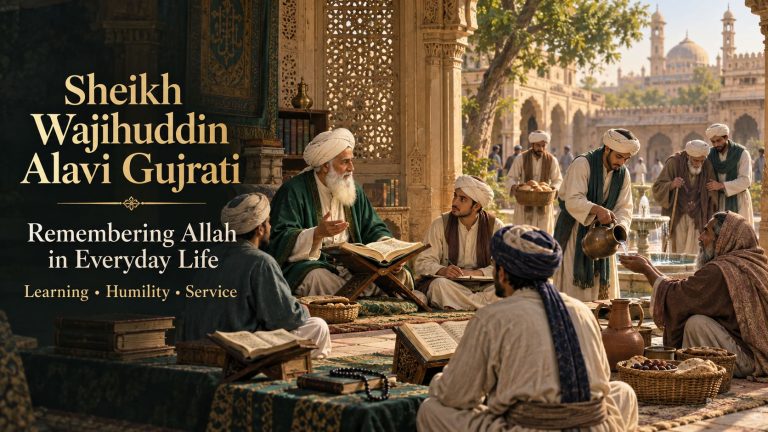
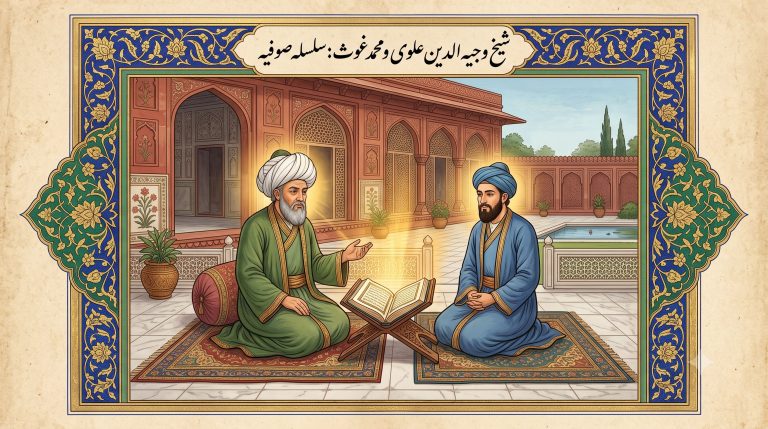
The library associated with Sheikh Wajihuddin Alavi Gujrati was more than a room filled with books. In the accounts available to us, it supported a madrasa, preserved works by teachers and students, and depended on the skilled labour of readers, scribes, and organizers. [1, 2]
Its story also warns us about the fragility of scholarly heritage. The two supplied books describe loss, dispersal, and later attempts to identify surviving manuscripts. Those accounts help explain why a book title, a manuscript copy, and a present library holding must be treated as three different kinds of evidence.
A library connected to teaching
Mohammad Khalid’s thesis places the library within Sheikh Wajihuddin’s educational work in Ahmedabad. Its discussion follows the description of the madrasa, its curriculum, and its care for students. The books were therefore part of an active teaching environment rather than a private collection valued only for display. [1]
Mustafa Husain Alvi’s English biography gives a similar picture. He describes a collection containing works on many subjects, including rare books and writings by Sufis of Gujarat. He also connects the collection with books written by Wajihuddin’s students. This is Alvi’s transmitted account, not a modern shelf-by-shelf survey, but it preserves a valuable memory of the library’s breadth. [2]
The larger bibliography associated with Sheikh Wajihuddin supports that picture of a wide curriculum. Works attributed to him engage Qur’anic interpretation, hadith methodology, law, inheritance, grammar, rhetoric, logic, theology, and spiritual teaching. A library serving such a school would have needed base texts, commentaries, glosses, teaching copies, and devotional works.
Shah Hamid as scribe and organizer
Alvi identifies Sheikh Wajihuddin’s son Shah Hamid as a central figure in the library. His account describes Shah Hamid as a reader, writer, collector, critic, and organizer with accomplished handwriting. It says he copied many of his father’s manuscripts and managed both the school library and the personal collection. [2]
A later passage repeats the memory of Shah Hamid as a learned person and skilled scribe. [3] These statements belong to a family and devotional biography, so their exact scope requires comparison with dated manuscripts. Even so, they draw attention to work that historical summaries often overlook.
Before printing, preserving a scholar’s work required repeated human decisions. Someone had to prepare paper, copy the text, distinguish the base work from marginal notes, correct mistakes, label gatherings, and keep the volume where students could use it. A scribe was therefore part of the intellectual history of a book, not merely a person who reproduced words.
Loss and dispersal
Both books describe the collection as suffering after the institution’s earlier period of strength. Khalid gathers reports about books passing into different collections and about the difficulty of tracing the original library. Alvi gives a more dramatic loss narrative involving discontinued support, poor storage, termites, and theft. [1, 2]
These accounts should remain attributed. They do not provide a complete inventory of what was lost, when every movement occurred, or where each surviving volume is now. Alvi’s dating of the school’s decline also conflicts with other chronological statements in the same supplied copy, so it should not be used as a precise closing date without further research.
What the accounts establish more safely is the nature of the preservation problem. A historical library can disappear as one organized collection while individual books continue elsewhere. Some may enter public libraries, family collections, shrines, or teaching institutions. Others may survive only as titles quoted by later bibliographers.
What later manuscript descriptions can prove
Khalid’s thesis distinguishes works whose manuscripts he could describe from additional titles known through earlier references. It also records a manuscript of Sheikh Wajihuddin’s sayings at Maulana Azad Library and an Awrad collection reported in another historical collection. [4]
These records are important, but they have limits. A manuscript copy does not automatically prove that it is in the author’s own hand. A copyist’s date tells us when that copy was completed, not when every saying was first spoken. A location recorded in a 2011 thesis should not be presented as a guarantee of present access without checking the current catalogue.
The most useful modern record for each manuscript would include the title in its original script, author attribution, copyist, date, opening and closing lines, number of folios, physical condition, library, shelfmark, and a link to a lawful digital image when available.
Preservation as a form of service
The library story brings together teaching, family effort, scribal skill, institutional support, and later research. It also shows why responsible digital preservation is more than uploading a list of titles.
A reliable project would begin with the 23 works that Khalid classifies as located or described, then verify each catalogue record with the holding institution. The 44 additional titles can remain in a separate research list until manuscript evidence is found. Such a project would honour the tradition by making its evidence clearer, searchable, and useful to future scholars.
The enduring lesson is practical: scholarship survives when people teach from books, copy them accurately, describe them honestly, and care for the institutions that hold them.
Sources
- Mohammad Khalid, Life and Works of Sheikh Wajihuddin Alavi Gujrati, PhD thesis, Aligarh Muslim University, 2011, printed pp. 219-220; supplied PDF pp. 256-257. Earlier library accounts are cited through Khalid unless stated otherwise.
- Mustafa Husain Alvi, The Sun in a Candle: Life and Teachings of Hazrat Shah Wajeehuddin Alvi, supplied undated PDF, p. 83.
- Alvi, p. 97. The description of Shah Hamid is transmitted through Alvi’s biography.
- Khalid, printed pp. 413-414; supplied PDF pp. 450-451, for the manuscript descriptions of the Malfuzat and Awrad.