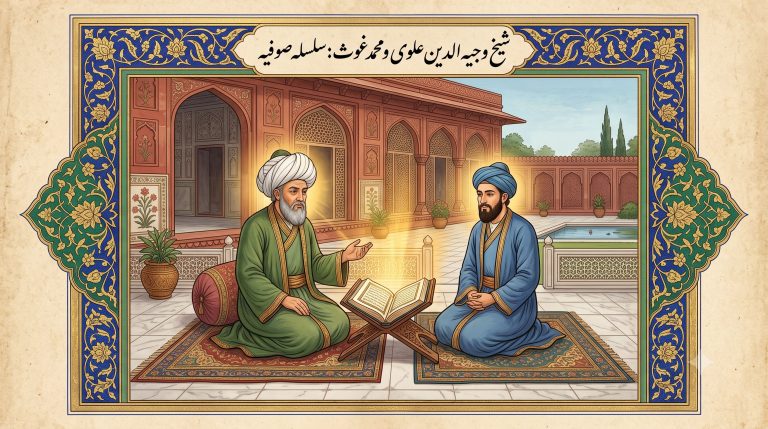
A reader scanning the works attributed to Sheikh Wajihuddin Alavi Gujrati will find many titles connected with Arabic grammar, syntax, semantics, and rhetoric. These subjects were not secondary ornament. They were essential tools for reading the Qur’an, hadith, law, theology, and poetry with precision.
Language as a scholarly instrument
Arabic grammar studies how words change and how sentences are constructed. Rhetoric asks how wording, order, emphasis, comparison, and figurative expression shape meaning. In the traditional curriculum, these disciplines prepared students to understand why a small grammatical or rhetorical choice could affect interpretation.
For a scholar teaching advanced religious texts, language study supported nearly every other subject. A legal argument may depend on whether a command is general or restricted. A theological passage may turn on reference and qualification. A Qur’anic commentary may assume that the reader recognizes ellipsis, metaphor, or a shift in word order.
A network of texts and commentaries
Khalid’s thesis examines several relevant works attributed to Wajihuddin, including writing connected with Sharh al-Jami, al-Irshad of Qadi Shihab al-Din al-Dawlatabadi, and the rhetorical tradition around al-Taftazani’s al-Mutawwal. The titles show him working within established teaching books rather than attempting to replace the whole curriculum with a single independent manual.
This is characteristic of commentary culture. A concise text supplied the structure. A commentary opened its arguments. A gloss addressed points that still required explanation. Teachers and students could move between these layers while keeping a common reference point.
The method also made disagreement visible. A scholar could preserve the wording of an earlier authority, then question a definition, propose a clearer reading, or cite another interpretation in the margin.
Evidence left by the manuscripts
The thesis reproduces useful catalogue observations. One description of a manuscript linked with al-Jami’s commentary notes that quotations were marked in red and that marginal corrections were written in naskh. It records the copy as dated 1005 AH. This helps distinguish quoted material from the later explanation and shows that readers corrected the text as it circulated.
An India Office catalogue entry describes a commentary by “Wajih b. Nasr Allah b. Imad Alawi.” It says the work was written during the reign of Mahmud III ibn Latif ibn Muzaffar Shah of Gujarat, whose reign is given as 944-961 AH, and notes that a commentary by Wajih al-Din of Gujarat is mentioned in a Leiden manuscript of the original work.
That notice is valuable because it connects author identification, place, political chronology, and another manuscript witness. It still requires careful comparison with the physical copies. Similar names, later copyists, and abbreviated titles can mislead a catalogue user who does not inspect the opening and closing statements.
Why red ink and margins matter
In a layered scholarly manuscript, layout carries meaning. Red ink may mark the words of the base commentary. Black ink may carry the gloss. Marginal notes can record a correction, an alternative reading, or the intervention of a later teacher. Blank space may show that a rubricator never completed the planned markers.
Modern readers often meet these works as a flat list of titles. The manuscript page tells a richer story: teaching, copying, correction, and repeated reading. It also warns editors to separate Wajihuddin’s contribution from quotations and later annotations before translating the work.
Scholarship in service of understanding
These writings show why Sheikh Wajihuddin’s reputation cannot be reduced to a single field. His Sufi teaching developed in the same intellectual environment as grammar, rhetoric, Qur’anic interpretation, hadith, law, and logic.
Language disciplines trained attention. They asked the reader to notice the exact form of a word, the relation between clauses, and the effect of an expression. That habit of careful reading is part of the legacy preserved in the manuscripts associated with his school.
Source note
Based on Mohammad Khalid, Life and Works of Sheikh Wajihuddin Alavi Gujrati, PhD thesis, Aligarh Muslim University, 2011. Relevant sections begin at printed pp. 345, 360, and 388 (supplied PDF pp. 382, 397, and 425); catalogue passages discussed here appear on supplied PDF pp. 391 and 412-413.